
Tulja Bhavani Temple, Solapur: Complete Pilgrimage Guide
The Shri Tulja Bhavani Temple, located in Tuljapur, Maharashtra, stands as one of India’s most revered Shakti Peethas and holds a special place in the hearts of devotees, particularly as the family deity (Kuldevi) of Chhatrapati Shivaji Maharaj . This comprehensive guide provides detailed information about the temple’s address, distance, history, architecture, and practical tips for visitors.
Temple Address and Location Details
| Detail | Information |
|---|---|
| Temple Name | Shri Tulja Bhavani Temple |
| Address | Mahadwar Rd, Jijamata Nagar, Tuljapur, Maharashtra – 413601 |
| District | Dharashiv district (formerly Osmanabad) |
| Coordinates | 18.011386° N, 76.125641° E |
| Elevation | 648 meters (2,126 feet) above sea level |
| Nearest City | Solapur (45 km) |
The temple is situated on the Yamunachala Hill in the Balaghat mountain range, overlooking the Mandakini River . This strategic location adds to the spiritual ambiance of the sacred site.
Distance from Major Cities
| City | Distance | Travel Time |
|---|---|---|
| Solapur | 45-48 km | 45-60 minutes |
| Dharashiv/Osmanabad | 30 km | 30-40 minutes |
| Pune | 290-295 km | 5-6 hours |
| Mumbai | 450 km | 8-9 hours |
| Hyderabad | 380 km approx | 7-8 hours |
| Kolhapur | 275 km | 5-6 hours |
The driving distance between Solapur and Tulja Bhavani Temple is approximately 47 km, with a bearing of 23 degrees northeast . The well-maintained Solapur-Tuljapur highway makes the journey convenient for pilgrims.
Historical Significance
Ancient Origins
The temple’s history dates back to the 12th century CE, when it was built by Maratha Mahamandaleshwara Māradadeva of the Kadamb dynasty . However, the shrine’s spiritual significance is much older, with references found in the Skanda Purana .
The Legend of Goddess Tulja Bhavani
According to ancient scriptures, a sage named Kardama lived with his wife Anubhuthi in this region. After the sage’s death, Anubhuthi performed intense penance on the banks of the Mandakini River, seeking the goddess’s protection for her infant child . A demon named Kukur (or Madhu-Kaitabh) attempted to disturb her penance, upon which Goddess Bhavani appeared and vanquished the demon. Pleased with Anubhuthi’s devotion, the goddess chose to reside on the Balaghat hill, coming to be known as Tulja Bhavani .
Connection with Chhatrapati Shivaji Maharaj
The temple holds immense historical significance as the Kuldevi (family deity) of the Bhosale dynasty. Chhatrapati Shivaji Maharaj, the founder of the Maratha Empire, was a devout worshipper who frequently visited this temple to seek the goddess’s blessings . According to legend, the goddess bestowed upon him the divine Bhavani sword (Bhavani Talwar), which became instrumental in his military campaigns and the establishment of Swarajya .
One of the Four Great Shakti Peethas
The Tulja Bhavani Temple is one of the four great Shakti Peethas in Maharashtra, alongside:
- Renuka Temple at Mahur
- Mahalaxmi Temple at Kolhapur
- Saptashringi Temple at Vani
Temple Architecture
Hemadpanthi Style
The temple exemplifies the Hemadpanthi architectural style, characterized by robust black stone construction, intricate carvings, and massive entrance gates . This architectural tradition, named after the 13th-century prime minister Hemadpant, is notable for its use of interlocking stone blocks without mortar.
Main Sanctum and Idol
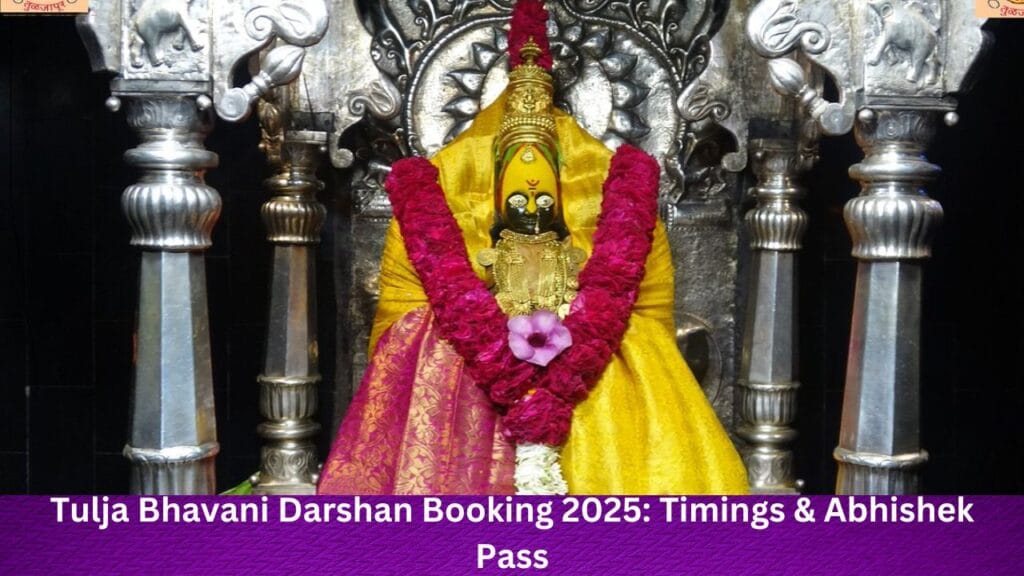
The sanctum sanctorum (garbhagriha) houses the three-foot-tall granite idol of Goddess Tulja Bhavani, which is believed to be swayambhu (self-manifested) . The goddess is depicted with eight arms, each bearing symbolic weapons, triumphantly standing over the slain demon Mahishasura . The idol is adorned daily with traditional Maharashtrian saree, jewelry, a golden crown (mukut), nose ring, and fresh flowers .
The Three Entrances
The temple complex features three distinct entrance gates:
| Entrance | Named After | Significance |
|---|---|---|
| Sardar Nimbalkar Entrance | Sardar Nimbalkar | Main entrance; leads to Markandeya Rishi temple |
| Raja Shahaji Mahadwar | Shahaji Maharaj (father of Shivaji) | One of the main gates |
| Rajmata Jijau Mahadwar | Jijabai (mother of Shivaji) | The other principal entrance |
Sacred Water Tanks
Within the temple premises are two holy water tanks:
- Gomukh Theerth: Located on the right side after descending the stairs; water is used for the goddess’s abhishekam
- Kallol Theerth (Kalakh): Situated on the left side; devotees take a ritual dip here before entering the sanctum
Other Shrines in the Complex
The temple complex houses several other significant shrines:
- Siddhi Vinayak Temple: Dedicated to Lord Ganesha, located on the left side of the main gate
- Matangi Devi Temple: Dedicated to the tantric manifestation of Saraswati
- Adi Maya Adi Shakti Temple: Located north of the main temple; pooja here precedes the main deity’s worship
- Annapurna Temple: Dedicated to the goddess of nourishment
- Markandeya Rishi Temple: Found inside the Sardar Nimbalkar entrance
- Datta Temple: Within the main complex
Additional Features
- Yagna Kund: A holy fire pit located in front of the main temple
- Deepa Stambha: A tall lamp tower illuminated during festivals
- Libraries: Two religious libraries—Shree Santh Dnyaneshwar Dharmik Library and Shree Tukaram Dharmik Library—are located near the main gates
Darshan Timings
The temple is open daily with the following schedule:
| Activity | Time |
|---|---|
| Temple Opens | 4:00 AM |
| Kakad Aarti (Morning) | 5:00 AM |
| Regular Darshan | Throughout the day |
| Temple Closes | 10:00 PM |
Special Opening Days
On Tuesdays, Fridays, and Sundays, the temple opens for darshan from 1:00 AM, allowing devotees to seek blessings during the early hours .
Daily Ritual Schedule
| Ritual | Time |
|---|---|
| Chaughada (Drumming) | 5:00 AM |
| Charantirtha Puja | 5:30 AM |
| Abhishekam (Morning) | 9:00 AM |
| Dhup Aarti | 12:00 PM (Noon) |
| Abhishekam (Evening) | 6:00 PM |
| Shejarti (Night Ritual) | After 8:00 PM |
Darshan Passes and Fees
Free Darshan
General darshan is free for all devotees. However, during festivals and weekends, wait times can extend to several hours .
Special Darshan (Denagi Darshan)
For faster access, devotees can purchase a special darshan pass priced at ₹200 per person . These passes are available:
- At the underground floor of the administrative building
- Online through the official temple website
- Via the temple’s mobile app
Parking Fee
A parking/entrance fee of ₹50 per vehicle is charged, collected at the designated parking area before the Bhakt Niwas .
Chintamani Consultation
Devotees seeking guidance on important decisions can consult the Chintamani (a sacred black stone near the main temple) for a fee of ₹10 per question . The stone’s movement is believed to indicate answers—right movement for positive outcomes, left for negative, and stillness for indecisive answers .
How to Reach
By Road
Tuljapur is well-connected by road to major cities in Maharashtra and neighboring states :
- MSRTC Buses: Regular AC and non-AC bus services from Pune, Solapur, Dharashiv, Latur, Nashik, Kolhapur, Nanded, and Hyderabad
- Private Vehicles: The Pune-Solapur highway provides a smooth driving experience
| Origin | Road Distance |
|---|---|
| Pune | 290 km |
| Mumbai | 450 km |
| Solapur | 45 km |
| Hyderabad | 380 km approx |
By Train
The nearest railway stations are:
| Station | Distance |
|---|---|
| Solapur Junction | 45 km |
| Dharashiv (Osmanabad) | 30 km |
By Air
| Airport | Distance |
|---|---|
| Solapur Airport | 45 km |
| Pune Airport | 290 km |
Facilities for Devotees
Bhakt Niwas (Pilgrim Lodging)
The temple trust manages accommodation facilities for pilgrims. Advance booking is recommended, especially during festival seasons.
Amenities
- Amphitheater Seating: Tiered seating arrangements provide unobstructed views of rituals and cultural events
- Live Darshan: The temple broadcasts aartis and special ceremonies through television channels and the Jio TV network; a mobile app is available for live darshan and e-pass bookings
- Homa: Sacred fire rituals conducted by learned priests; devotees can take home bhasma (embers) as prasad
- Drinking Water: Available throughout the complex
- Restrooms: Maintained facilities for pilgrims
Nearby Attractions
| Site | Distance | Significance |
|---|---|---|
| Yamai Devi Temple | Within Tuljapur | Elder sister of Tulja Bhavani |
| Mardi | 35 km | Sub-shrine of Yamai Devi |
| Akkalkot | 38 km | Shri Swami Samarth Temple |
| Pandharpur | 74 km | Vitthal Rukmini Temple |
| Aundh | 215 km | Original seat of Yamai Devi |
Frequently Asked Questions (FAQs)
Q1: What is the exact location of Tulja Bhavani Temple?
The temple is located at Mahadwar Rd, Jijamata Nagar, Tuljapur, Dharashiv district, Maharashtra – 413601 .
Q2: How far is the temple from Solapur?
The temple is approximately 45-48 km from Solapur, with a driving time of about 45-60 minutes .
Q3: What are the temple darshan timings?
The temple is open from 4:00 AM to 10:00 PM daily. On Tuesdays, Fridays, and Sundays, darshan begins at 1:00 AM .
Q4: Is there a special darshan pass available?
Yes, special darshan passes (Denagi Darshan) are available for ₹200 per person, offering faster access during peak hours .
Q5: What is the significance of Chintamani?
Chintamani is a sacred black stone near the main temple where devotees seek answers to important questions. A ₹10 fee is charged per question .
Q6: Is there any dress code for the temple?
Traditional attire is recommended out of respect for the sacred space. Men often wear dhoti or trousers with upper cloth; women typically wear saree or salwar kameez.
Q7: What is the best time to visit?
While the temple is open year-round, winter months (November to February) offer pleasant weather. Major festivals like Navratri (September-October) and Shakambhari Navratri (December-January) see grand celebrations but also larger crowds .
Q8: Who is the Kuldevi of Tulja Bhavani?
Tulja Bhavani is the family deity (Kuldevi) of the Bhosale dynasty and is revered by numerous Maratha clans and other Marathi castes as their Kulswamini .
Q9: How can I book accommodation?
Accommodation at Bhakt Niwas can be booked through the temple administration. Online booking may be available through the official website or mobile app .
Q10: Is photography allowed inside the temple?
Photography is generally restricted inside the sanctum sanctorum. Visitors should check with temple authorities regarding current policies.
Q11: What is the parking fee?
The parking fee is ₹50 per vehicle, collected at the designated parking area .
Q12: Can I watch darshan online?
Yes, the temple offers live darshan streaming through various television channels and the Jio TV network. A mobile app is also available for live darshan and e-pass bookings .
Summary Table: Temple Information at a Glance
| Aspect | Details |
|---|---|
| Location | Tuljapur, Dharashiv district, Maharashtra |
| Address | Mahadwar Rd, Jijamata Nagar, Tuljapur – 413601 |
| Distance from Solapur | 45-48 km (1 hour drive) |
| Darshan Timings | 4:00 AM – 10:00 PM daily |
| Special Darshan Pass | ₹200 per person |
| Parking Fee | ₹50 per vehicle |
| Architectural Style | Hemadpanthi (12th century) |
| Deity | Goddess Bhavani (eight-armed form of Durga) |
| Significance | One of 51 Shakti Peethas; Kuldevi of Shivaji Maharaj |
| Nearest Airport | Solapur (45 km), Pune (290 km) |
| Nearest Railway | Solapur Junction (45 km) |
Conclusion
The Shri Tulja Bhavani Temple is not merely a place of worship but a profound spiritual destination that embodies centuries of devotion, history, and cultural heritage. Whether you seek divine blessings, wish to explore the magnificent Hemadpanthi architecture, or simply experience the powerful spiritual ambiance, a visit to Tuljapur promises to be an enriching journey.
For a smooth pilgrimage experience, plan your visit during weekdays to avoid crowds, consider purchasing a special darshan pass during peak seasons, and take advantage of the temple’s online resources for live darshan and advance bookings. May Mata Tulja Bhavani bless your journey.
Note: Temple timings, fees, and other details are subject to change. Devotees are advised to verify current information through the official temple website or authorities before planning their visit.