
Located in the historic town of Samarlakota (Samalkot) in Andhra Pradesh’s East Godavari district, the Sri Chalukya Kumararama Bhimeswara Swamy Temple is one of the five sacred Pancharama Kshetras dedicated to Lord Shiva . This ancient shrine, lovingly called Kumararama, derives its name from Lord Kumara Swamy (Kartikeya), who is believed to have installed and consecrated the Shiva Lingam here .
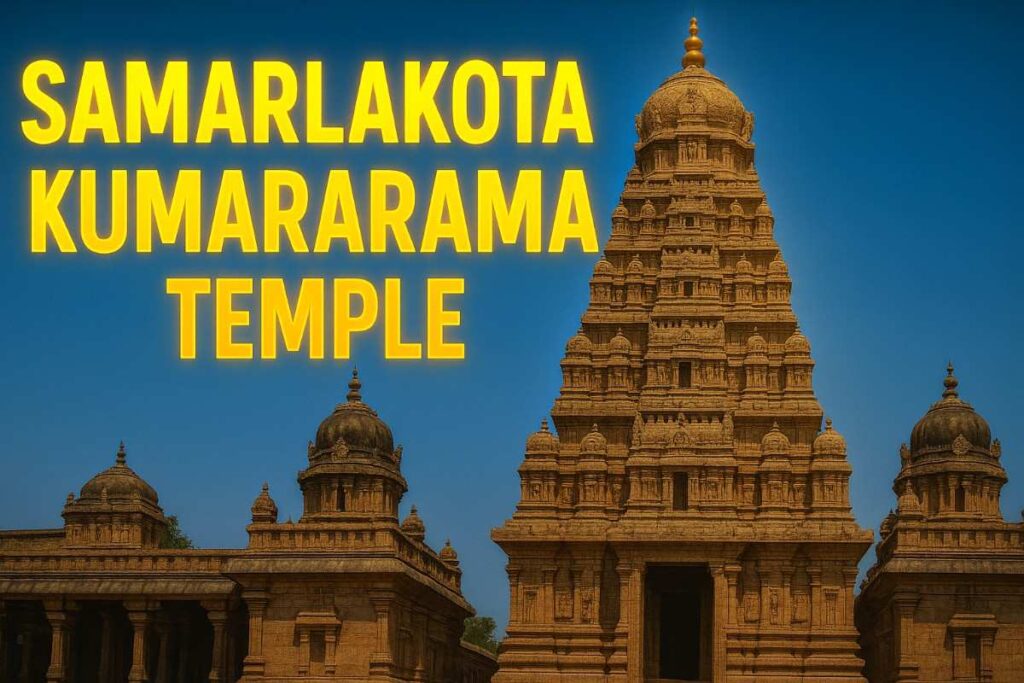
The temple’s origins trace back to the late 9th century, specifically between 892 and 921 AD, when it was commissioned by the powerful Eastern Chalukyan King, Chalukya Bhima I. The king built this architectural marvel to commemorate his monumental success in winning 360 battles against his enemies . Architecturally, the temple is a twin to the Draksharamam temple, reflecting the distinctive “Pancharama” style of the Chalukyan era. The structure is built entirely of stone, featuring a unique two-story sanctum designed to house a massive 14-foot white limestone Lingam—a feat of engineering that has stood the test of time for over a millennium .
What makes this temple truly unique is the blend of spiritual lore and astronomical precision. The temple’s design demonstrates the advanced scientific knowledge of the Chalukyan architects—during specific periods of the year, the morning sun’s rays travel through the pillared corridors to fall directly at the base of the 14-foot Lingam . The temple also features a special Nandi idol called Ekasila Nandi, carved from a single stone, and the main entrance is known as Surya Dwaram .
Kumararama Temple 2026: Overview Table
| Detail Category | Information |
|---|---|
| Temple Name | Sri Chalukya Kumararama Bhimeswara Swamy Temple |
| Location | Samarlakota (Samalkot), East Godavari District, Andhra Pradesh – 533440 |
| Primary Deity | Lord Shiva as Bhimeswara Swamy (14-foot white limestone Lingam) |
| Goddess | Bala Tripura Sundari Devi |
| Spiritual Significance | One of the five Pancharama Kshetras; Lingam installed by Lord Kumara Swamy |
| Historical Era | 9th Century CE (892–921 AD), Eastern Chalukya Dynasty |
| Architectural Style | Dravidian / Chalukyan with two-story sanctum, 100-pillar mandapam |
| Unique Features | 14-ft Lingam spanning two floors, Ekasila Nandi, Surya Dwaram |
| Entry Fee | Free for general darshan |
| Darshan Timings | 6:00 AM – 12:00 PM & 4:00 PM – 8:00 PM daily |
| Abhishekam Timings | 6:00 AM – 12:00 PM daily |
| Best Time to Visit | October to March; Maha Shivaratri (February-March) |
| Official Contact | +91 88972 05858 |
| Nearest Railway Station | Samalkot Junction – 1.5 km; Kakinada – 12-15 km |
| Nearest Airport | Rajahmundry Airport – 46 km; Visakhapatnam Airport – 156 km |
Kumararama Temple Darshan Timings 2026
The temple follows a consistent daily schedule throughout the year, with an afternoon break. According to multiple sources, here are the confirmed timings for 2026:
| Session | Timings | Days |
|---|---|---|
| Temple Opens | 6:00 AM | Monday – Sunday |
| Morning Darshan | 6:00 AM – 12:00 PM | Monday – Sunday |
| Afternoon Break | 12:00 PM – 4:00 PM | Monday – Sunday |
| Evening Darshan | 4:00 PM – 8:00 PM | Monday – Sunday |
| Temple Closes | 8:00 PM | Monday – Sunday |
Source:
Special Festival Timings
During Maha Shivaratri, the temple remains open continuously from 6:00 AM to 8:00 PM without any afternoon break. Special pujas and aartis are held throughout the day .
Daily Abhishekam & Pooja Schedule
| Ritual | Timings | Days |
|---|---|---|
| Suprabhata Seva / Nitya Archana | Starts around 6:30 AM | Monday – Sunday |
| Abhishekam | 7:00 AM – 9:00 AM (general) / 6:00 AM – 12:00 PM (full window) | Monday – Sunday |
| Maha Nivedana & Harathi | Around 11:30 AM and 7:30 PM | Monday – Sunday |
Source:
Best Time for Darshan
- Early morning (6:00 AM – 9:00 AM) is the most peaceful with fewer crowds
- Weekdays are generally less crowded than weekends
- Mondays, Pradosham days, and during Masik Shivratri are considered highly auspicious with special poojas
- Karthika and Margashira months (November-December) feature daily Abhishekam with special rituals
Kumararama Temple Sevas and Price Offerings 2026
The temple offers various sevas and pooja offerings for devotees. General darshan is free, while special services have nominal fees. All sevas must be booked in person at the temple counter—no online booking system is currently available .
Seva Price List 2026
| Seva / Offering | Price (INR) | Details |
|---|---|---|
| General Darshan | Free | Available to all devotees |
| Abhishekam (One-time) | ₹300 | Ritual bathing of the Lingam |
| Prasadam (One-time) | ₹300 | Sanctified food offering |
| Saswatha Abhishekam | ₹1,116 | Annual abhishekam performed once a year as per devotee request |
| Saswatha Prasadam | ₹1,116 | Annual prasadam offering |
Important Notes on Sevas
- No online booking system is currently available—all sevas must be booked in person at the temple counter
- During Karthika and Margashira months (November-December), daily Abhishekam is performed with special fervor
- Special poojas and homams are performed on Mondays, Pradosham days, and during Masik Shivratri
- There are no special darshan facilities; all devotees can perform general darshan, which is completely free
History and Legend of Kumararama Temple
Mythological Origin – The Legend of Tarakasura
According to the Skanda Purana and Brahmanda Purana, the temple’s history is rooted in the epic battle between the demon king Tarakasura and Lord Kumaraswamy (Kartikeya), the son of Lord Shiva and Goddess Parvati .
The legend tells that the demon Tarakasura stole the divine “Amrutha Atma Lingam” that emerged during the churning of the ocean (Ksheerasagar Mathanam) and wore it around his neck, making himself invincible . When Kumaraswamy battled Tarakasura, he repeatedly broke the demon’s body into pieces, but the pieces kept rejoining due to the power of the Lingam.
Lord Vishnu advised Kumaraswamy that the only way to defeat the demon was to break the Shiva Lingam itself. Following this advice, Kumaraswamy used his Agni weapon to shatter the Shiva Lingam into five pieces. Each sacred fragment fell at a different location, which later became the five Pancharama Kshetras :
- Draksharamam – where one piece fell
- Kumararama (Samarlakota) – where one piece fell
- Amararama (Amaravati) – where one piece fell
- Ksheerarama (Palakollu) – where one piece fell
- Somarama (Bhimavaram) – where one piece fell
Lord Kumara Swamy himself is said to have installed and consecrated the Lingam here to pacify its immense power, giving the temple its name—Kumararama .
Historical Construction
The historical narrative of the temple dates back to the late 9th century, specifically between 892 and 921 AD. It was commissioned by the powerful Eastern Chalukyan King, Chalukya Bhima I. The king built this architectural marvel to commemorate his monumental success in winning 360 battles against his enemies .
Throughout the centuries, the temple has been protected and patronized by various dynasties, including the Musunuri Nayaks and the Vijayanagara Emperors, ensuring that it remained not just a place of worship, but a symbol of the cultural and spiritual resilience of the Andhra region .
Unique Architectural Features
The 14-Foot Shiva Lingam
The presiding deity is Lord Shiva, represented as a magnificent 14-foot tall Shiva Lingam made of white limestone (crystal) spanning two floors—a unique architectural feature that sets this temple apart from others . When standing in the sanctum, you can only see a portion of the towering Lingam, creating a sense of awe and reverence.
Astronomical Precision
The temple’s design demonstrates the advanced scientific knowledge of the Chalukyan architects. They constructed the temple in such a way that during specific periods of the year, the morning sun’s rays travel through the pillared corridors to fall directly at the base of the 14-foot Lingam .
Other Architectural Highlights
- Ekasila Nandi: A special Nandi idol carved from a single stone, located opposite Lord Shiva Lingam at the entrance
- Surya Dwaram: The main entrance of the temple is called Surya Dwaram
- Prakara Walls: The temple is surrounded by two Prakara walls made of dressed sandstone
- Hundred-Pillar Mandapam: The temple features a stunning four-entrance mandapam supported by a hundred pillars
- Apsara Sculptures: The temple walls feature beautiful apsara sculptures
Major Festivals Celebrated
| Festival | Time | Significance |
|---|---|---|
| Maha Shivaratri | February-March | Most important festival; temple remains open continuously from 6:00 AM to 8:00 PM; car festival organized |
| Kalyana Mahotsav | Magha Bahula Ekadashi day | Celebrates the divine marriage of Lord Shiva and Goddess Parvati |
| Karthika Masam | October-November | Daily Abhishekam performed with special rituals throughout the month |
| Navaratri | September-October | 10-day festival with special poojas |
| Saran Nava Rathrulu | During Dasara | Special celebrations |
How to Reach Kumararama Temple
By Air
- Nearest Domestic Airport: Rajahmundry Airport – approximately 46 km from Samarlakota
- Nearest International Airport: Visakhapatnam Airport – approximately 156 km from Samarlakota
From the airport, you can hire a taxi or take a bus to Samarlakota.
By Train
- Nearest Railway Station: Samalkot Junction – just 1.5 km from the temple
- Alternate Station: Kakinada Railway Station – approximately 12-15 km away
The temple is easily accessible from Samalkot Junction by auto-rickshaw or taxi (short ride).
By Road
- Samarlakota is well-connected by road along the National Highway passing through the town
- Regular APSRTC buses connect Samarlakota to major cities including Hyderabad, Vijayawada, Rajahmundry, and Visakhapatnam
- Distances: 12-15 km from Kakinada, 40 km from Annavaram, 46 km from Rajahmundry
Local Transport
Auto-rickshaws and taxis are readily available for local travel within Samarlakota. The town is small and easy to navigate .
Nearby Attractions
When visiting Kumararama Temple, you can explore these nearby attractions:
| Attraction | Distance | Description |
|---|---|---|
| Draksharamam Temple | 30 km | Another Pancharama Kshetram; one of the 18 Maha Shakti Peethas |
| Annavaram Satyanarayana Swamy Temple | 40 km | Famous hilltop temple dedicated to Lord Satyanarayana |
| Kakinada Beach | 15 km | Scenic beach perfect for relaxing and sunset views |
| Coringa Wildlife Sanctuary | Near Kakinada | Biodiversity hotspot with mangroves and estuarine crocodiles |
| Thalupulamma Thalli Temple | Near Kakinada | Famous temple where devotees offer prayers after purchasing new vehicles |
| Muramulla Sri Veereswara Swamy Temple | Konaseema region | Famous for Nitya Kalyanam (daily wedding ceremony) |
| Ryali Jaganmohini Kesava Swamy Temple | Konaseema region | Unique temple with intricate carvings |
Accommodation Options
Near the Temple
Several budget hotels and lodges are available in Samarlakota town:
- R & B Guest House at Peddapuram – approximately 5 km from the temple
- Other local lodges and guest houses within walking distance of the temple
Nearby Cities (More Options)
For more comfortable accommodation options:
- Kakinada (12-15 km): Options include Grand Kakinada by GRT Hotels, Royal Park Hotel
- Rajahmundry (46 km): Wide range of hotels from budget to luxury
Suggested Stays
- Paradigm Sarovar Portico – Premium hotel in Kakinada offering a luxurious experience
- APTDC Haritha Hotel – Government-run accommodation with decent facilities
Important Visitor Instructions
Dress Code
- Traditional and formal clothing is recommended as a mark of respect
- Avoid shorts, sleeveless tops, and revealing attire
Photography
- Photography is not allowed inside the main sanctum
- Respect the sanctity of the temple and follow the guidelines
Temple Etiquette
- Remove footwear before entering the temple premises
- Maintain silence and peaceful conduct inside
- Follow the queue system; avoid pushing or rushing
Facilities
- Prasadam is available at the temple
- Drinking water and restroom facilities are available
- If traveling with elderly or children, carry water and snacks as the area around is more traditional than touristy
Best Time to Visit Kumararama Temple
Season Guide
| Season | Months | Weather | Recommendation |
|---|---|---|---|
| Winter | October – March | Pleasant, mildly cold evenings | Best time to visit |
| Summer | April – June | Hot and dry | Avoid due to extreme heat |
| Monsoon | July – September | Heavy rainfall | May affect travel plans |
Festival Visits
- Maha Shivaratri (February-March): Most spiritually vibrant time, but expect large crowds
- Karthika Masam (November-December): Daily Abhishekam with special rituals
- Kalyana Mahotsav (Magha Bahula Ekadashi): Special celebrations
Frequently Asked Questions (FAQs)
Q1: What are the Kumararama Temple darshan timings for 2026?
A: The temple is open from 6:00 AM to 12:00 PM (morning session) and 4:00 PM to 8:00 PM (evening session) daily. There is an afternoon break from 12:00 PM to 4:00 PM .
Q2: Is there an entry fee for Kumararama Temple?
A: No, entry for general darshan is completely free for all devotees. Charges apply only for specific sevas like Abhishekam .
Q3: What is the cost of Abhishekam at Kumararama Temple?
A: One-time Abhishekam costs ₹300. Saswatha (annual) Abhishekam costs ₹1,116 .
Q4: Can I book sevas or darshan tickets online?
A: As of 2026, there is no online booking system available. All sevas and poojas must be booked in person at the temple counter .
Q5: What is the unique feature of the Shiva Lingam at this temple?
A: The temple houses a 14-foot tall white limestone Shiva Lingam spanning two floors—a unique architectural feature found only at this Pancharama Kshetra .
Q6: How far is the temple from Samalkot Railway Station?
A: Samalkot Junction is approximately 1.5 km from the temple. Auto-rickshaws are readily available .
Q7: What are the major festivals celebrated at Kumararama Temple?
A: Major festivals include Maha Shivaratri, Kalyana Mahotsav, Karthika Masam, and Navaratri .
Q8: What is the significance of Kumararama Temple?
A: It is one of the five Pancharama Kshetras, where Lord Kumara Swamy installed a fragment of the divine Shiva Lingam after defeating the demon Tarakasura .
Q9: When is the best time to visit Kumararama Temple?
A: The best time is from October to March when the weather is pleasant. Early morning (6:00 AM – 9:00 AM) is ideal for a peaceful darshan .
Q10: What is the nearest airport to Kumararama Temple?
A: The nearest domestic airport is Rajahmundry Airport, approximately 46 km away. The nearest international airport is Visakhapatnam, about 156 km away .
Q11: What is Ekasila Nandi?
A: Ekasila Nandi is a special Nandi idol carved from a single stone, located opposite Lord Shiva Lingam at the entrance of the temple .
Q12: Are there any other Pancharama temples nearby?
A: Yes, Draksharamam is about 30 km away, and other Pancharama temples are located across the Godavari districts .
Temple Contact Information
| Purpose | Details |
|---|---|
| Temple Name | Sri Chalukya Kumararama Bhimeswara Swamy Temple |
| Address | Samarlakota, East Godavari District, Andhra Pradesh – 533440 |
| Contact Number | +91 88972 05858 |
| Nearest Railway Station | Samalkot Junction (1.5 km) |
| Nearest Airport | Rajahmundry Airport (46 km) |
Conclusion
The Sri Chalukya Kumararama Bhimeswara Swamy Temple in Samarlakota stands as a magnificent testament to India’s rich spiritual heritage and architectural brilliance. As one of the five Pancharama Kshetras, it offers devotees a unique opportunity to connect with the divine through its towering 14-foot Lingam and ancient Chalukyan architecture. The temple’s 14-foot Lingam spanning two floors, the astronomical precision of its design, and the powerful legend of Lord Kumara Swamy make it a must-visit destination for pilgrims and history enthusiasts alike.
Whether you are on a pilgrimage to all five Pancharama temples or visiting as part of a larger tour of East Godavari’s sacred sites, Kumararama promises a deeply fulfilling spiritual experience. Plan your visit during the cooler months of October to March, arrive early morning for a peaceful darshan, and immerse yourself in the timeless devotion that has flowed through this sacred place for over a thousand years.