
Located in the bustling Karmanghat area of Hyderabad, the Sri Karmanghat Hanuman Temple is one of the city’s oldest and most revered spiritual landmarks. Dedicated to Lord Hanuman in a unique Dhyana Anjaneya Swamy form—seated in deep meditation rather than the typical standing posture—this 12th-century shrine offers a distinctive spiritual experience .
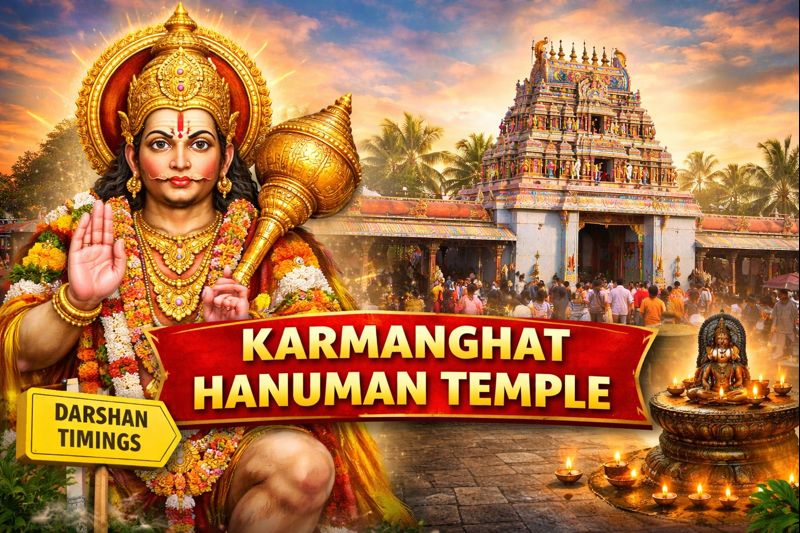
What makes this temple truly special is its serene atmosphere amidst urban Hyderabad. Unlike many temples where the deity is depicted in a combative or devotional stance, Lord Hanuman here sits in a peaceful lotus position (Padmasana), holding a mace (gada) and a rosary (japa mala), symbolizing the perfect balance between physical strength and spiritual discipline . This meditative form attracts devotees seeking not just material blessings but inner peace, mental clarity, and relief from life’s obstacles.
The temple has also been a silent witness to centuries of history, from the Kakatiya dynasty to the Mughal era. Legend has it that even Emperor Aurangzeb’s army could not breach its sanctity, leading to the temple’s unique name—”Kar-man-ghat”—meaning “harden your heart” or “fort of the forehead” . Today, thousands of devotees flock here daily, especially on Tuesdays and Saturdays, to seek the blessings of Lord Hanuman, the remover of obstacles and the embodiment of unwavering devotion.
Karmanghat Hanuman Temple Darshan Timings 2026
Planning your visit around the temple’s schedule ensures a smooth and spiritually fulfilling experience. The temple has an afternoon break, so timing is essential.
Daily Darshan Schedule
| Day | Morning Hours | Afternoon Break | Evening Hours |
|---|---|---|---|
| Monday | 6:00 AM – 12:00 PM | 12:00 PM – 4:30 PM | 4:30 PM – 8:30 PM |
| Tuesday | 5:30 AM – 1:00 PM | 1:00 PM – 4:30 PM | 4:30 PM – 9:00 PM |
| Wednesday | 6:00 AM – 12:00 PM | 12:00 PM – 4:30 PM | 4:30 PM – 8:30 PM |
| Thursday | 6:00 AM – 12:00 PM | 12:00 PM – 4:30 PM | 4:30 PM – 8:30 PM |
| Friday | 6:00 AM – 12:00 PM | 12:00 PM – 4:30 PM | 4:30 PM – 8:30 PM |
| Saturday | 5:30 AM – 1:00 PM | 1:00 PM – 4:30 PM | 4:30 PM – 9:00 PM |
| Sunday | 6:00 AM – 12:00 PM | 12:00 PM – 4:30 PM | 4:30 PM – 8:30 PM |
*Sources: *
Key Timing Notes
- Tuesdays and Saturdays are the busiest days as they are considered highly auspicious for Lord Hanuman worship. The temple opens earlier (5:30 AM) and closes later (9:00 PM) on these days .
- Darshan is NOT available during the afternoon break. Plan to arrive either in the morning before closing or after 4:30 PM .
- Estimated darshan time on regular weekdays is approximately 1 to 1.5 hours. On Tuesdays, Saturdays, and festivals, waiting times can be longer.
Best Time to Visit for a Peaceful Darshan
For a calm, less crowded experience, consider these time slots:
| Recommendation | Details |
|---|---|
| Best Time of Day | Early morning (6:00 AM – 7:30 AM) or late evening (7:00 PM – 8:30 PM) |
| Best Days | Monday, Wednesday, Thursday (avoid Tuesdays and Saturdays if possible) |
| Best Season | October to March (pleasant weather) |
The Unique Dhyana Anjaneya Form: Understanding the Deity
What Makes This Temple Special?
The presiding deity at Karmanghat is Dhyana Anjaneya Swamy—Lord Hanuman in a meditative seated posture . This is a rare depiction because:
- Most Hanuman temples show the Lord in a standing posture (either with folded hands in devotion or holding a mace ready for action).
- Here, Hanuman sits in Padmasana (lotus position) holding a gada (mace) in one hand and a japa mala (rosary) in the other, symbolizing the balance between strength and spiritual wisdom .
The Meaning of the Name “Karmanghat”
The temple’s name has a fascinating origin rooted in legend. When Mughal Emperor Aurangzeb attempted to destroy the temple, a divine voice is said to have thundered from the heavens:
“Mandir todna hai raja, to kar man ghat”
This translates to: “O King, if you want to destroy this temple, harden your heart (or forehead).” Overcome by fear, Aurangzeb retreated, and the place came to be known as Kar-man-ghat (Fort of the Heart/Forehead) .
The Spiritual Benefits (Phalaśruti)
According to temple lore and devotee belief, worship at this temple offers specific spiritual benefits :
| Benefit | Description |
|---|---|
| Cleansing Ancestral Karma | Rituals here are believed to pacify pitru doshas and bring peace to ancestors |
| Overcoming Obstacles | The meditative form of the deity grants mental strength to navigate life’s challenges |
| Protection from Evil | As the guardian of the south (Dakshinamukha), Lord Hanuman shields devotees from negative energies |
| Healing Powers | The temple is renowned for its healing prowess against ailments |
Temple History: From Kakatiya Kings to Mughal Miracles
The Divine Discovery (12th Century)
The temple’s origins date back to the 12th century (approximately 1143–1198 CE) during the reign of the Kakatiya dynasty .
According to legend, Kakatiya King Prola II (or Prataparudra II, according to some sources) was hunting in the dense forests near his capital. Exhausted, he rested under a tree and heard a mystical chanting of Lord Rama’s name emanating from a nearby stone. Upon investigation, he discovered a self-manifested (Swayambhu) idol of Lord Hanuman seated in meditation .
That night, Lord Hanuman appeared in the king’s dream and instructed him to build a temple at that very spot. The temple was constructed immediately and flourished under successive rulers .
The Aurangzeb Miracle (17th Century)
Approximately 400 years later, during the Mughal expansion of the Deccan, the temple faced a severe trial. According to tradition, Emperor Aurangzeb ordered his armies to destroy Hindu temples across the region. However, when his forces approached Karmanghat, they could not even cross the compound wall—repelled by an invisible, divine force .
Frustrated, Aurangzeb himself went to the temple with a crowbar to demolish it. As he approached the threshold, a deafening roar rumbled like thunder, and the crowbar slipped from his hands as he trembled in fear. Then a voice thundered from the heavens: “Mandir todna hai raja, to kar man ghat” (“If you want to destroy this temple, harden your heart”) .
Aurangzeb retreated, and the temple remained untouched, giving the area its name—Karmanghat—meaning “fort of the heart/forehead” .
Temple Architecture & Other Deities
The Sanctum and Sculpture
The sanctum sanctorum houses the Swayambhu (self-manifested) idol of Lord Hanuman. The sculpture features the Lord seated in Padmasana, holding a gada and a japa mala. While not a classical Nagara or Dravidian structure, the temple exhibits robust stone masonry typical of the Kakatiya period, featuring intricately carved pillars and a modest Shikhara (tower) that has been renovated over time .
Other Deities in the Complex
The temple complex also houses shrines for several other deities, making it a comprehensive pilgrimage circuit within a single enclosure :
| Deity | Significance |
|---|---|
| Lord Rama | Lord Hanuman’s revered Lord |
| Lord Shiva | The Mahadeva shrine within the complex |
| Goddess Durga | The divine mother |
| Goddess Saraswati | Goddess of knowledge |
| Goddess Santoshimata | Bestower of contentment |
| Lord Venugopala Swamy | A form of Lord Krishna |
| Lord Jagannath | The Lord of the Universe |
This unique combination allows devotees to worship multiple deities in one visit, fulfilling a complete spiritual journey.
Sevas, Poojas & Price Offerings 2026
Entry and Darshan
| Service | Price |
|---|---|
| General Darshan | Free |
| VIP Darshan | Included with certain pooja bookings (see below) |
Seva Price List
| Seva / Pooja Name | Price Range (INR) | Details |
|---|---|---|
| Sindoor Offering | ₹50 – ₹100 | Sacred vermilion offering |
| Butter Offering | ₹50 – ₹100 | Traditional offering to Lord Hanuman |
| Archana | ₹100 – ₹300 | Recitation of 108 names |
| Sankata Hara Chaturthi Puja | ₹500 – ₹1,000 | Special puja for relief from obstacles |
| Abhishekam | ₹500 – ₹1,000 | Ritual bathing of the deity; performed daily at 8:00 AM |
| Special Pooja | ₹500 – ₹2,000 | Customized rituals; includes VIP Darshan |
| Hanuman Jayanti / Ram Navami Pooja | ₹1,000 – ₹2,000 | Festival-specific special offerings |
| Sahasra Namarchana | (Varies) | Recitation of thousand names of Hanuman |
| Annadanam (Donation) | ₹501 and above | Sponsor free meals for devotees |
Important Note on VIP Darshan
The temple offers VIP Darshan benefits for devotees who book any pooja in the ₹500 – ₹2,000 range. These benefits typically include :
- Priority darshan access
- Special pooja participation
- Sacred prasadam
For general devotees, the temple also provides a separate queue for senior citizens and differently-abled persons .
How to Book Darshan & Seva Online (2026 Guide)
Official Booking Portal
The official website for online bookings is: karmanghattemple.telangana.gov.in
Step-by-Step Online Booking Process
Step 1: Visit the Official Website
Go to karmanghattemple.telangana.gov.in
Step 2: Sign Up / Login
- New users: Register with your name, mobile number, and email address
- Existing users: Log in directly with your credentials
Step 3: Navigate to “Online Booking”
From the menu, select “Online Booking” to view available services
Step 4: Select Your Darshan Type / Seva
Choose from options like:
- Special Darshan
- Abhishekam
- Archana
- Sankata Hara Chaturthi Puja
- Festival-specific poojas
Step 5: Choose Date & Time Slot
Select your preferred date and available time slot. Note that slots for Tuesdays and Saturdays fill quickly .
Step 6: Enter Devotee Details
Provide required information including:
- Full name
- Mobile number
- Address
Step 7: Complete Payment
Proceed to payment using:
- UPI
- Net Banking
- Debit/Credit Card
Step 8: Download Your E-Ticket
After successful payment, download or print your e-ticket. You will also receive a confirmation SMS .
Offline Booking
If you prefer to book in person:
- Visit the temple ticket counter
- Inquire about available seva slots
- Pay at the counter and receive a physical ticket
Note: Online booking is recommended for festival periods like Hanuman Jayanti (April 12, 2026) and Ram Navami (April 5, 2026) .
2026 Major Festival Dates
| Festival | 2026 Date | Day | Significance |
|---|---|---|---|
| Maha Shivaratri | February 26, 2026 | Thursday | Night-long vigil and Abhishekam at the Shiva shrine |
| Ugadi (Telugu New Year) | March 30, 2026 | Monday | Temple opens early for special pujas |
| Sri Rama Navami | April 5, 2026 | Sunday | Grand processions within Karmanghat |
| Hanuman Jayanti | April 12, 2026 | Saturday | Special Alankaram and Sahasra Deepalankara Seva; most important festival |
| Sankata Hara Chaturthi | Monthly | Varies | Special pooja for relief from obstacles |
Note: On Hanuman Jayanti, expect very heavy crowds. Advance booking is strongly recommended .
How to Reach Karmanghat Hanuman Temple
Location
Address: Sri Karmanghat Hanuman Devasthanam, Saroornagar, Rangareddy District, Telangana – 500079
Landmark: Near Santoshnagar, on the Nagarjuna Sagar Ring Road (NH-65) .
By Air
| Airport | Distance | Travel Time |
|---|---|---|
| Rajiv Gandhi International Airport (HYD) | Approximately 20 km | 30-40 minutes by taxi |
By Train
| Station | Distance | Details |
|---|---|---|
| Hyderabad Deccan (Nampally) | Approximately 12 km | Taxis and auto-rickshaws available |
| Secunderabad Junction | Approximately 10 km | Well-connected from across India |
By Road
- From Mahatma Gandhi Bus Terminal (MGBS): Approximately 12 km; frequent TSRTC buses to Karmanghat
- By Car/Taxi: Take the Nagarjuna Sagar Ring Road (NH-65) and exit at the Karmanghat/Santoshnagar junction
- By Auto-rickshaw: Easily available from LB Nagar, Champapet, and Santoshnagar
Nearest Metro Station
The nearest metro stations are LB Nagar or Moosapet depending on the line. From the station, you will need to take an auto-rickshaw or cab (approx. 3–5 km) to reach the temple .
Nearby Attractions
| Attraction | Distance | Highlights |
|---|---|---|
| Chilkur Balaji Temple | ~15 km | Famous “Visa Balaji” temple on Osman Sagar lake |
| Birla Mandir | ~12 km | Stunning marble temple on a hillock |
| Charminar & Mecca Masjid | ~12 km | Iconic monuments of Hyderabad |
| Golconda Fort | ~16 km | Historic fort with light and sound show |
Important Visitor Instructions
Dress Code
The temple recommends modest traditional attire :
| Category | Recommended Attire | Not Permitted |
|---|---|---|
| Men | Dhoti or pyjamas with upper cloth; shirt & trousers | Shorts, sleeveless tops |
| Women | Saree, half-saree, salwar kameez with dupatta | Shorts, mini-skirts, sleeveless tops |
Note: While there is no strict dress code enforced, covering shoulders and knees is recommended as a sign of respect .
Prohibited Items
- Mobile phones inside the sanctum
- Photography inside the temple (strictly prohibited)
- Leather items (belts, wallets, shoes) – use cloakroom facilities
- Footwear – remove at designated shoe stand
Facilities Available
| Facility | Details |
|---|---|
| Free Annadanam | Free meals served daily; on Tuesdays and Saturdays, free food is provided to all devotees; on other days, meals are provided to the poor and needy |
| Cloakroom | For depositing belongings |
| Drinking Water | Available on premises |
| Parking | Available near the temple |
| Prasadam | Available at temple counters |
Frequently Asked Questions (FAQs)
Q1: What are the Karmanghat Hanuman Temple darshan timings for 2026?
A: Morning darshan: 6:00 AM – 12:00 PM (5:30 AM – 1:00 PM on Tuesdays and Saturdays). Evening darshan: 4:30 PM – 8:30 PM (9:00 PM on Tuesdays and Saturdays). The temple is closed from 12:00 PM to 4:30 PM daily .
Q2: Is there an entry fee for Karmanghat Hanuman Temple?
A: No, general darshan is completely free for all devotees .
Q3: How can I book VIP Darshan online?
A: Booking any pooja between ₹500 and ₹2,000 online automatically includes VIP Darshan access. Book through the official website: karmanghattemple.telangana.gov.in .
Q4: What is the cost of Abhishekam at the temple?
A: Abhishekam costs between ₹500 and ₹1,000. It is performed daily at 8:00 AM .
Q5: What is unique about the Hanuman idol at this temple?
A: The idol is in a Dhyana Anjaneya form—Lord Hanuman seated in meditation (Padmasana), holding a mace and rosary, which is rare compared to the typical standing posture .
Q6: What is the significance of the name “Karmanghat”?
A: The name comes from the divine voice heard during Aurangzeb’s attempted destruction of the temple: “Mandir todna hai raja, to kar man ghat” (If you want to destroy this temple, harden your heart), giving the place its name—Kar-man-ghat .
Q7: Is Annadanam (free food) available at the temple?
A: Yes, free meals are served daily. On Tuesdays and Saturdays, food is provided to all devotees; on other days, it is provided to the poor and needy .
Q8: Which days are most crowded at the temple?
A: Tuesdays and Saturdays are the busiest days as they are considered highly auspicious for Lord Hanuman worship .
Q9: Can I perform Rudrabhishekam at this temple?
A: Yes, the temple complex houses a shrine for Lord Shiva. Rudrabhishekam and other Shiva rituals can be performed upon prior booking with the temple priests .
Q10: Is photography allowed inside the temple?
A: No, photography is strictly prohibited inside the sanctum .
Temple Contact Information
| Purpose | Details |
|---|---|
| Official Website | karmanghattemple.telangana.gov.in |
| Alternate Website | karmanghatsrihanumantemple.org |
| Phone Number | +91-40-2422 2222 |
| Ticket Inquiry | +91-1800-425-46464 |
| Alternate Contact | 9704175441 |
| Address | Sri Karmanghat Hanuman Devasthanam, Saroornagar, Rangareddy District, Telangana – 500079 |
| Nearest Landmark | Inner Ring Road, Virat Nagar, Champapet |
Conclusion
The Karmanghat Hanuman Temple is more than a place of worship—it is a living monument to faith, history, and divine protection. From its discovery by Kakatiya kings in the 12th century to the miraculous events that saved it from Mughal destruction, this ancient shrine has stood as a testament to the power of devotion for over 800 years.
For your 2026 visit, plan your darshan during early morning hours for a peaceful experience, consider booking a special pooja online if you wish to receive VIP Darshan benefits, and respect the temple’s traditions by dressing modestly and maintaining silence in the sanctum. Whether you are seeking relief from obstacles, healing from ailments, or simply a moment of peace in the presence of Dhyana Anjaneya, this sacred space welcomes all with the same unwavering grace that has protected it for centuries.