
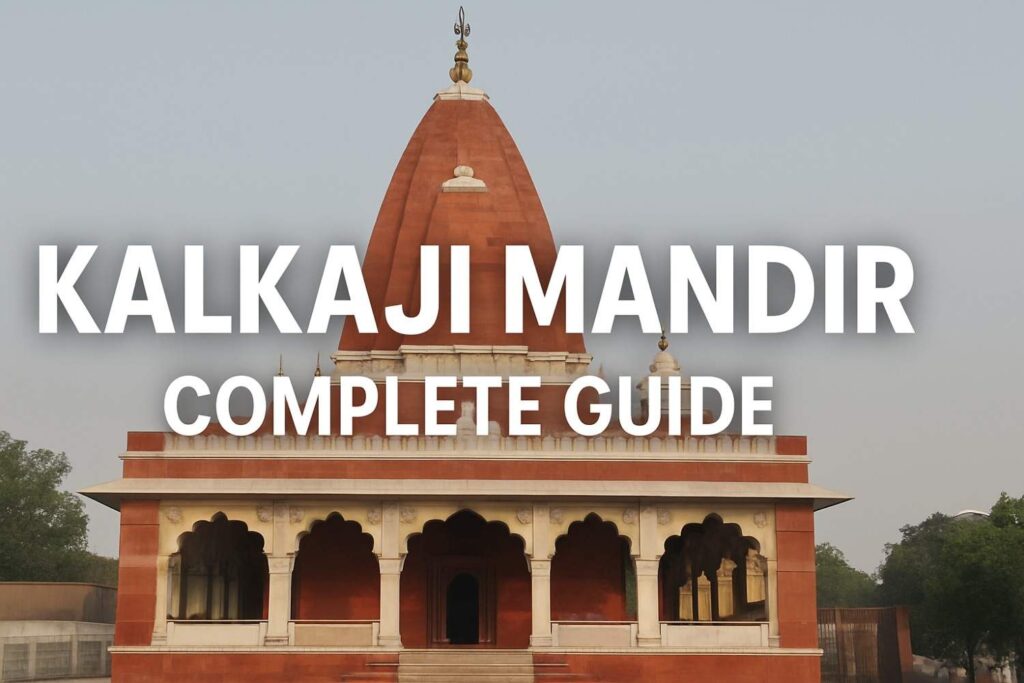
Kalkaji Mandir, situated in South Delhi near Nehru Place and directly opposite the famous Lotus Temple, is one of the oldest and most revered Shakti Peeth temples in North India . Dedicated to Goddess Kalka, a fierce and powerful form of Maa Durga (also identified with Goddess Kali), this temple is believed to be self-manifested (Swayambhu), radiating immense spiritual energy that draws devotees from across the country .
The temple holds a special place as a “Siddh Peeth” and is popularly called “Manokamna Siddh Peeth” or “Jayanti Peetha,” meaning the holy shrine where sincere prayers lead to the fulfillment of wishes . People visit from Delhi, NCR, and across India seeking blessings for health, career, marriage, children, exams, business, and overall protection from negative forces .
The temple’s significance goes back to ancient times. According to Hindu tradition, the site has been revered since Satya Yuga, and it is believed that the Pandavas and Lord Krishna themselves worshipped the Goddess here before the Mahabharata war . The name “Kalkaji” has given the surrounding locality its identity—the Kalkaji neighborhood in South Delhi derives its name directly from this temple, highlighting its long-standing influence on the area’s development .
Kalkaji Mandir Daily Darshan Timings 2026
The temple remains open every day of the week, including weekends and public holidays, ensuring devotees can plan their visit conveniently at any time . Below are the complete timings for 2026:
Complete Darshan Schedule
| Session | Timings | Details |
|---|---|---|
| Temple Opens | 4:00 AM | Morning gates open |
| Morning Darshan | 4:00 AM – 12:00 PM | First major darshan session |
| Afternoon Break | 12:00 PM – 4:00 PM | Temple closed for cleaning and Shringar |
| Evening Darshan | 4:00 PM – 11:30 PM | Evening session |
| Temple Closes | 11:30 PM | Final closure for the day |
Source:
Important Notes on Timings:
- Darshan is available throughout the day except during short intervals when the temple is closed for cleaning and before aartis
- During major festivals such as Navratri, Ashtami, and during the Chaitra and Kartik months, the temple often remains open for extended hours or even overnight for special jagrans
- There is a short break from approximately 12:00 PM to 4:00 PM when the temple closes for cleaning and deity preparation (Shringar)
- Some sources indicate a more granular schedule: 4:00 AM–5:30 AM, 6:30 AM–11:45 AM, 12:15 PM–3:00 PM, 4:00 PM–7:30 PM, and 8:30 PM–11:30 PM
Kalkaji Mandir Aarti Schedule 2026
Attending the daily aartis at Kalkaji Mandir is a deeply spiritual experience. Each aarti is performed with devotion, traditional rituals, and music, creating an uplifting atmosphere . Here is the complete aarti schedule:
| Aarti Name | Timing | Significance |
|---|---|---|
| Mangala Aarti | 4:30 AM | Morning wake-up ceremony; most peaceful time |
| Bhog Aarti | 12:00 PM | Noon offering of food to the deity |
| Sandhya Aarti | 7:00 PM | Evening prayer ceremony with lamps |
| Shayan Aarti | 10:30 PM | Night prayer before temple closes |
Source:
Special Notes on Aartis:
- Devotees can attend these aartis without needing any special pass on regular days
- During Navratri and other major festivals, the aartis become even more grand and vibrant, featuring live devotional music, bhajans, and extended rituals
- The evening aarti (Sandhya) around 7:00 PM is particularly popular and creates a mesmerizing atmosphere with glowing diyas and devotional chanting
- On regular days, aarati timings may shift slightly with the seasons; it’s advisable to confirm locally during your visit
Kalkaji Mandir VIP Darshan Pass – Price and Details
To help devotees manage long queues during busy days and major festivals, Kalkaji Mandir offers a VIP Darshan Pass. This pass allows visitors to reach the sanctum quickly and enjoy a more comfortable darshan experience, especially during Navratri and other high-traffic festivals .
VIP Pass Details
| Feature | Details |
|---|---|
| VIP Pass Price | ₹150 – ₹300 per person |
| Availability | On-site at the temple during Navratri and major festivals |
| Online Booking | Currently not available officially |
| Purpose | Skip long queues; ideal for elderly devotees, families, and large groups |
Source:
Important Tips for VIP Pass:
- Always purchase VIP passes at official counters inside the temple to avoid fake agents or third-party scams
- VIP passes are recommended for those who want a faster, hassle-free darshan during festival seasons
- Using the VIP pass allows devotees to focus on prayers and rituals without worrying about waiting in long lines
- Beware of agents offering fake passes; no official online booking system exists as of 2026
Navratri 2026 at Kalkaji Mandir – Dates, Crowd, and Special Arrangements
Navratri transforms Kalkaji Mandir into one of the most vibrant spiritual hubs of Delhi. During the nine-day festival, lakhs of devotees queue up, the temple remains decorated and illuminated, and continuous bhajans and aartis fill the air .
Navratri 2026 Dates
Navratri is celebrated twice a year:
| Navratri | 2026 Dates | Significance |
|---|---|---|
| Chaitra Navratri | March 19 – March 27, 2026 | Spring Navratri; marks the beginning of Hindu New Year |
| Sharad Navratri | October 2026 (dates to be confirmed) | Autumn Navratri; most widely celebrated |
Note: The Chaitra Navratri 2026 begins on March 19 and continues until March 27 .
Navratri Crowd and Experience
- Long Queues: Long queues often start forming from the early hours, with waiting times extending to several hours
- Barefoot Pilgrims: Many devotees walk in bare feet for several kilometers as an act of devotion
- Special Rituals: Jagrans (all-night devotional singing), special aartis, and elaborate decorations transform the temple complex
- Fair-like Atmosphere: Local vendors selling pooja items, prasad, toys, bangles, and street food line the approach roads, creating a festive, carnival-like environment
Traffic and Crowd Management for Navratri 2026
Delhi Traffic Police has implemented a comprehensive traffic management plan for Navratri 2026 to handle the surge of devotees . Here’s what to expect:
Affected Routes Near Kalkaji Mandir:
- Outer Ring Road: from Chirag Delhi/Savitri Cinema flyover to Modi Mill flyover
- Maa Anandmai Marg: from Crowne Plaza to Kalkaji Temple
- Captain Gaur Marg and Aastha Kunj Road
Traffic Restrictions (March 19-27, 2026):
- Traffic may be regulated or diverted depending on vehicle volume, between 7:00 AM and 11:00 PM
- Parking strictly prohibited on Outer Ring Road between Nehru Place and Modi Mill flyover
- Movement of heavy goods vehicles restricted around Kalkaji on a need basis
Pedestrian Safety Measures:
- Pedestrians urged to use foot overbridges to cross Outer Ring Road
- Avoid walking on central verges or jumping railings
- Stick to designated footpaths and channelisers
Noise and Safety Regulations:
- Use of loudspeakers prohibited after 10:00 PM as per Supreme Court and CPCB guidelines
- Strict penalties for reckless driving and playing loud music from vehicles
Best Time to Visit Kalkaji Mandir for a Peaceful Darshan
Planning your visit around the right time can make your darshan significantly more peaceful and spiritually fulfilling .
Recommended Time Slots
| Time Slot | Advantages | Disadvantages |
|---|---|---|
| Early Morning (5:00 AM – 7:00 AM) | Peaceful atmosphere, fewer crowds, witness Mangala Aarti | Requires waking up very early |
| Late Evening (After 8:00 PM) | Quieter experience, attend Sandhya Aarti | Temple closes at 11:30 PM |
| Weekdays | Significantly less crowded than weekends | Limited time for working professionals |
Times to Avoid
- Midday (10:00 AM – 2:00 PM): Peak crowd hours, especially on Sundays and Tuesdays
- Sundays and Tuesdays: These days see the heaviest footfall throughout the year
- Navratri and Festival Days: While spiritually vibrant, waiting times can extend to several hours
Best Months to Visit
- October to March: Pleasant weather makes darshan comfortable
- Sharad Navratri (October): Most spiritually vibrant time (though crowded)
- Chaitra Navratri (March-April): Spring festival with pleasant weather
History and Legends of Kalkaji Mandir
Ancient Origins and Legend
The site of Kalkaji Mandir is believed to be one of the oldest Shakti worship spots in Delhi, with traditions suggesting the shrine existed even in Satya Yuga . According to Hindu legend, the Goddess Kalika was born at the very site where the temple now stands .
The most famous legend tells of the demon Raktabij, who had the terrifying ability to multiply each time a drop of his blood fell on the ground. According to the story, Maa Kaushki Devi first attacked the giants but struggled as their spilled blood created more demons. Maa Parvati took compassion on her offspring, and from the eyebrows of Kaushki Devi came Maa Kali Devi, “whose lower lip rested on the hills below and the upper lip touched the sky above” . She drank the blood of the slaughtered giants before it could touch the ground, obtaining complete victory over the enemies. Maa Kali Devi then fixed her abode at this site .
The Pandavas and Lord Krishna are said to have worshipped the Goddess at this temple during the Mahabharata era, before the great war .
Historical Construction
While the temple is thought to be much older, the oldest portions of the present building are believed to have been constructed around 1764 AD by the Marathas . Later, in 1816, Mirza Raja Kidar Nath, the Peshkar (treasurer) of Mughal Emperor Akbar II, contributed to its expansion . The temple is built on land belonging to the Thok Jogians and Shamlat Thok Brahmins, who continue to perform the daily pujas and rituals, preserving the temple’s ancient spiritual traditions .
Architecture of Kalkaji Mandir
Kalkaji Mandir is a masterpiece of marble craftsmanship and traditional Indian temple architecture .
Key Architectural Features
- Central Chamber: A unique 12-sided design (dodecagon), 24 feet across, with a doorway on each side
- Verandah: Surrounds the central chamber, 8 feet 9 inches wide, containing 36 arched exterior doorways
- Pyramidal Tower: A shikhara (spire) rises above the structure, giving it a majestic presence
- Marble Finishes: The temple is constructed of brick masonry finished with plaster and marble
- Tiger Statues: Two red sandstone tigers sit on a marble pedestal opposite the eastern doorway, symbolizing the goddess’s strength
- Stone Idol: A carved stone idol of Maa Kali with her name engraved in Hindi, with a stone trident standing before it
Inscriptions
The pedestal and marble railings contain Nastaʿlīq-style inscriptions. One inscription reads: “Sri Dunga Singh for sawár – 1821 Fasli” (Sri Durga mounted on a lion – 1821 Fasli), indicating contributions from the Maratha period .
How to Reach Kalkaji Mandir (Complete Travel Guide)
Nearest Metro Station
| Metro Station | Lines | Walking Distance |
|---|---|---|
| Kalkaji Mandir Metro Station | Violet Line & Magenta Line (Interchange) | 5-10 minutes (400-500 meters) |
This is an interchange station named after the temple itself. Use the designated exit towards the temple/Nehru Place side for the shortest route .
By Road
| Transport Mode | Details |
|---|---|
| Nearest Railway Station | Hazrat Nizamuddin Railway Station – 7 km away |
| Nearest Airport | Indira Gandhi International Airport – 20 km away |
| Local Transport | Auto-rickshaws, taxis, e-rickshaws available from Nehru Place, Govindpuri, and Kalkaji |
| Bus Routes | DTC and cluster buses frequently pass through Nehru Place Terminal and bus stops labeled “Kalkaji Mandir” |
Temple Address
| Detail | Information |
|---|---|
| Temple Name | Kalkaji Mandir |
| Full Address | Block 9, Kalkaji, New Delhi, Delhi 110019, India |
| Google Plus Code | G7X5+QMQ |
| Landmark | Opposite Lotus Temple, Near Nehru Place |
| Coordinates | 28°32′59″N 77°15′39″E |
Nearby Attractions Worth Visiting
Kalkaji Mandir is ideally located near several other major attractions, making it perfect for a day trip:
| Attraction | Distance | Description |
|---|---|---|
| Lotus Temple (Baháʼí House of Worship) | Directly opposite | Iconic lotus-shaped temple open to all faiths |
| ISKCON Temple Delhi | Nearby (East of Kailash) | Hare Krishna temple with beautiful deities |
| Nehru Place | Adjacent | Major commercial hub for electronics and shopping |
| Ashokan Edict | Near East of Kailash | 3rd century BC rock edict of Emperor Ashoka |
| Greater Kailash (GK) Markets | 2-3 km | Upscale shopping and dining |
| Qutub Minar | 8-9 km | UNESCO World Heritage Site |
Important Visitor Guidelines and Dress Code
Dress Code
To maintain the sanctity of the temple, devotees are advised to follow these guidelines:
| Do’s | Don’ts |
|---|---|
| Wear modest, traditional Indian attire | Avoid shorts, mini-skirts, sleeveless tops |
| Cover shoulders and knees | Avoid revealing Western wear |
| Traditional saree, salwar, or kurta-pajama recommended | Avoid jeans with rips or inappropriate prints |
Temple Etiquette
- Footwear: Must be removed before entering temple premises
- Photography: Not permitted inside the main sanctum
- Queue Discipline: Respect the queue system and follow temple instructions
- Silence: Maintain quiet and peaceful conduct inside the temple
- Offerings: Can be purchased at vendors just before the entrance
- Security: Be alert for pickpockets, especially during crowded festival days
Prohibited Items
- Mobile phones inside the sanctum (may be restricted during aartis)
- Cameras and recording equipment
- Large bags and luggage
- Leather items
- Non-vegetarian food, alcohol, tobacco products
Nearby Accommodation Options
While Kalkaji Mandir itself does not provide on-site accommodation, several hotels and guest houses are available in the surrounding areas:
| Area | Distance from Temple | Price Range | Features |
|---|---|---|---|
| Nehru Place | 1-2 km | Budget to Mid-range | Business hotels, proximity to metro |
| Greater Kailash (GK) | 2-3 km | Mid-range to Luxury | Upscale residential area, good hotels |
| Kalkaji | Walking distance | Budget | Guest houses, simpler accommodations |
| Okhla | 2-3 km | Budget | Affordable options, industrial area |
Booking Tips:
- Book accommodation in advance during Navratri and festival seasons
- Look for hotels near Kalkaji Mandir Metro Station for convenient access
- Consider staying in South Delhi areas with good metro connectivity to the temple
Dos and Don’ts at Kalkaji Mandir
Dos
- Do arrive early morning (5:00 AM – 7:00 AM) for a peaceful darshan
- Do dress in modest, traditional attire as a mark of respect
- Do carry minimal belongings to move freely, especially during festivals
- Do consider VIP passes during Navratri for faster access if traveling with elderly or children
- Do use foot overbridges to cross Outer Ring Road during Navratri
- Do follow instructions from temple volunteers and security staff
Don’ts
- Don’t visit during midday (10:00 AM – 2:00 PM) on Sundays and Tuesdays if you want to avoid crowds
- Don’t carry large bags or backpacks into the temple complex
- Don’t attempt to take photographs inside the sanctum
- Don’t purchase VIP passes from unauthorized agents; only buy from official temple counters
- Don’t park illegally on Outer Ring Road during Navratri; strict enforcement applies
- Don’t use loudspeakers or play loud music after 10:00 PM in the temple vicinity
Frequently Asked Questions (FAQs)
Q1: What are the Kalkaji Mandir darshan timings for 2026?
A: The temple is open daily from 4:00 AM to 11:30 PM. There is a break from approximately 12:00 PM to 4:00 PM for cleaning and Shringar .
Q2: What is the cost of VIP darshan at Kalkaji Mandir?
A: VIP darshan passes cost between ₹150 and ₹300 per person and are available only on-site during Navratri and major festivals. No online booking is available .
Q3: Can I book Kalkaji Mandir darshan tickets online?
A: As of 2026, there is no official online booking system for Kalkaji Mandir. All darshan and VIP passes are available only on-site at the temple counters .
Q4: When are the aartis at Kalkaji Mandir?
A: Mangala Aarti: 4:30 AM, Bhog Aarti: 12:00 PM, Sandhya Aarti: 7:00 PM, Shayan Aarti: 10:30 PM .
Q5: What is the best time to visit Kalkaji Mandir?
A: Early morning (5:00 AM – 7:00 AM) is ideal for a peaceful darshan with fewer crowds. The best months are October to March for pleasant weather .
Q6: How do I reach Kalkaji Mandir by metro?
A: Take the Violet Line or Magenta Line to Kalkaji Mandir Metro Station. The temple is a 5-10 minute walk from the station .
Q7: What are the Navratri 2026 dates?
A: Chaitra Navratri 2026 is from March 19 to March 27. Sharad Navratri dates will be announced closer to October 2026 .
Q8: Will there be traffic restrictions during Navratri 2026?
A: Yes, traffic diversions are expected on Outer Ring Road, Maa Anandmai Marg, Captain Gaur Marg, and Aastha Kunj Road near Kalkaji Mandir from March 19-27, 2026 .
Q9: Is photography allowed inside Kalkaji Mandir?
A: No, photography is generally not permitted inside the main sanctum. It is advisable to check with temple staff for specific restrictions .
Q10: What is the dress code for Kalkaji Mandir?
A: Modest, traditional attire is recommended. Avoid shorts, mini-skirts, and sleeveless tops. Covering shoulders and knees is appreciated as a mark of respect .
Q11: What is the significance of Kalkaji Mandir?
A: It is one of the oldest Shakti Peeth temples in North India, believed to be self-manifested (Swayambhu). It is also called “Manokamna Siddh Peeth,” where sincere prayers are believed to be fulfilled .
Q12: Are there food options available near the temple?
A: Yes, during regular days and especially during Navratri, numerous vendors sell prasad, snacks, and meals on the approach roads to the temple .
Temple Contact Information
| Purpose | Details |
|---|---|
| Official Website | www.shrikalkajimandir.in |
| Ticket Inquiry Phone | +91-9205084060 |
| Address | Block 9, Kalkaji, New Delhi, Delhi 110019, India |
| Nearest Metro | Kalkaji Mandir Metro Station (Violet & Magenta Lines) |
| Landmark | Opposite Lotus Temple, Near Nehru Place |
Conclusion
Kalkaji Mandir stands as a beacon of spiritual power and devotion in the heart of South Delhi. As one of the oldest Shakti Peeths in North India and a revered “Manokamna Siddh Peeth,” it continues to draw millions of devotees seeking blessings, peace, and the fulfillment of their prayers .
Whether you are planning a quiet early morning darshan, hoping to witness the vibrant energy of Navratri, or seeking the convenience of a VIP pass during festivals, this guide provides all the information you need for a smooth and spiritually fulfilling visit in 2026. Plan your visit according to the timings, dress modestly, respect the temple’s traditions, and soak in the divine energy of Maa Kalkaji. May the Goddess bless your journey with peace, prosperity, and answered prayers.