
Rathasapthami is one of the most significant and spiritually charged festivals in the Hindu calendar, marking the birth of the Sun God, Surya. While celebrated across India with varying traditions, the festival takes on an extraordinary dimension at the Sri Venkateswara Temple in Tirumala. Here, Rathasapthami is not just a Sun worship festival it is famously known as the “Mini Brahmotsavam” , a day when the sacred hill town bursts into a non-stop celebration featuring seven different vahana sevas in a single day.
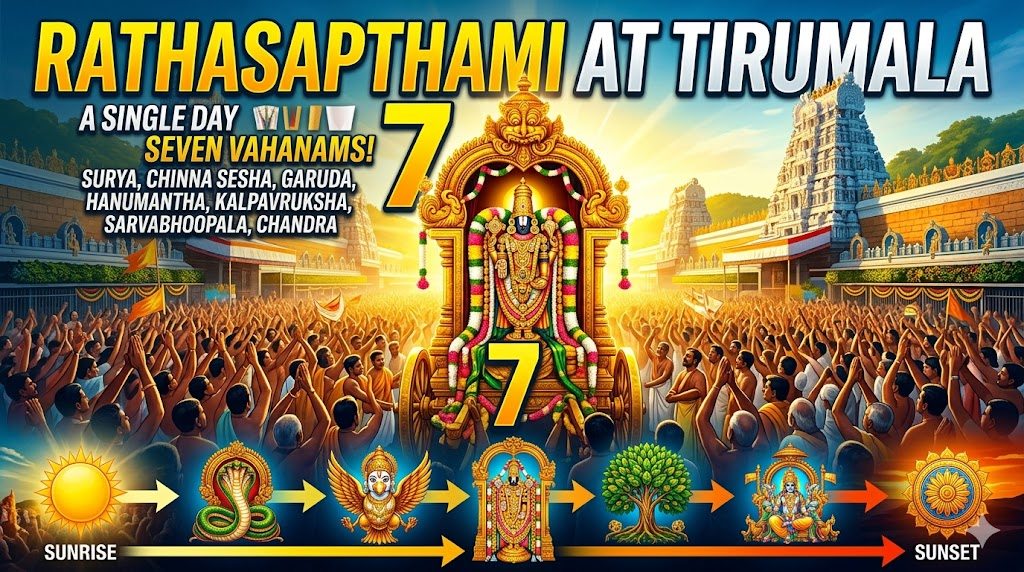
For devotees, attending Rathasapthami at Tirumala is considered doubly auspicious: they receive the blessings of Lord Venkateswara (an incarnation of Vishnu) and Surya Dev, the cosmic giver of life and health.
What is Rathasapthami?
The name is a combination of two Sanskrit words:
- Ratha means “chariot” – symbolizing the Sun God’s seven-horse chariot that traverses the sky.
- Sapthami means “seventh day” – referring to the seventh day (Shukla Paksha Saptami) of the bright fortnight in the Hindu month of Magha (January–February).
On this day, the Sun’s rays are believed to have unique healing properties, and the Sun God begins his northward journey (Uttarayana) in full force, signifying the end of winter and the arrival of spring.
Spiritual Significance of Rathasapthami
Rathasapthami represents spiritual awakening and purification. Just as the Sun dispels physical darkness, worshipping Surya on this day is believed to dispel:
- Ignorance and ego (the inner darkness)
- Health ailments (particularly skin diseases and eye problems)
- Karmic obstacles that delay liberation
In Hindu scriptures, Surya is the only visible deity, the “Pratyaksha Deva.” The festival encourages devotees to rise before sunrise, take a holy bath (often in the sea or sacred rivers), and offer Arghya (water offering) to the rising Sun while chanting the Gayatri Mantra or Aditya Hridayam.
Why Rathasapthami is Celebrated at Tirumala
At Tirumala, Lord Venkateswara is considered the supreme deity who encompasses all cosmic forces, including the Sun. The unique rituals on Rathasapthami highlight the syncretic nature of Vaishnavism, where Vishnu and Surya are seen as one. The temple celebrates this day with unmatched grandeur because:
- The Sun’s rays directly illuminate the sanctum sanctorum (garbha griha) at a specific hour, touching the Lord’s feet—a phenomenon similar to the famous Surya Puja at the Padmanabhaswamy Temple in Thiruvananthapuram.
- The festival serves as a “rehearsal” or mini-version of the annual Brahmotsavam, allowing devotees who cannot attend the 9-day event to witness similar processions.
- TTD views Rathasapthami as an opportunity to showcase all seven celestial vehicles (vahanas) in one compressed, spiritually intense day.
Rathasapthami 2026 Date and Timings
Based on the Hindu lunar calendar, Rathasapthami 2026 falls on Monday, January 26, 2026 (Republic Day in India).
| Event | Timing (Approx.) |
|---|---|
| Surya Arghya (offering to Sun) | 6:30 AM – 7:15 AM |
| Morning rituals at temple | 4:00 AM – 6:00 AM |
| First Vahana Seva (Surya Prabha) | 8:00 AM |
| Last Vahana Seva (Chandra Prabha) | 8:00 PM |
| Chakrasnanam | 5:00 PM |
Note: Exact timings are confirmed by TTD 2 weeks prior. Check the official TTD website or similar to Tirumala Arjitha Seva 2026 schedules for updates.
Story Behind Rathasapthami
The most popular legend behind Rathasapthami comes from the epic Mahabharata. The wise King Yudhishthira was advised by the sage Vyasa to observe Rathasapthami to overcome the sins of his kinsmen’s death in the Kurukshetra war. By worshipping Surya on this day with complete devotion, Yudhishthira was cleansed of his grief and guilt.
Another mythological account states that on this day, Surya Dev mounted his seven-horse chariot (driven by the charioteer Aruna) and began illuminating the three worlds after a long period of darkness. The seven horses represent the seven colors of the rainbow and the seven days of the week.
Surya Jayanti: Birth of the Sun God
Rathasapthami is also widely known as Surya Jayanti—the birth anniversary of Surya Dev. According to the Brahma Purana, Surya was born to Sage Kashyapa and Aditi on this very day. As the chief of the Navagrahas (nine planetary deities), Surya’s blessings are considered essential for good health, leadership, and clear vision.
In many parts of India, devotees prepare sweet pongal (chakkara pongal) as an offering to Surya, similar to the prasadam culture seen at the Guruvayur Temple, where the deity is offered vast quantities of this sweet dish.
Significance of Tirumala Rathasapthami Festival
Why do lakhs of devotees make a special effort to attend Rathasapthami at Tirumala? The reasons are both spiritual and experiential:
- Blessings of both Vishnu and Surya: You worship the Sun God in the morning and witness Lord Venkateswara in seven divine forms throughout the day.
- Seven Vahanas in one day: This compressed schedule means you can see what normally takes a full Brahmotsavam to display.
- Reduced crowd compared to Brahmotsavam: While crowded, it is more manageable than the September-October Brahmotsavam, making darshan possible even with free queues.
- Healing energies: Many believe the Sun’s rays on this day have therapeutic properties, especially for chronic skin ailments.
Unique Ritual: “Mini Brahmotsavam”
Tirumala’s Rathasapthami is famously called the Mini Brahmotsavam because it replicates the key processions of the annual 9-day Brahmotsavam but compresses them into a single day. While the main Brahmotsavam features processions morning and evening on different vahanas, Rathasapthami runs seven vahanas continuously from morning to night.
This is the only day in the Tirumala calendar when so many vahanas are taken out in a single day. The temple remains open from 3:00 AM to midnight, with priests and volunteers working in shifts to manage the non-stop rituals.
Seven Vahana Sevas in One Day
This is the highlight of Rathasapthami. Lord Venkateswara is taken on a grand procession on seven different vahanas (celestial vehicles), each with deep spiritual symbolism.
| # | Vahana Name | Time | Symbolism |
|---|---|---|---|
| 1 | Surya Prabha (Sun’s Radiance) | 8:00 AM | The Lord as the Sun God; golden hue |
| 2 | Chandra Prabha (Moon’s Radiance) | 10:00 AM | Cooling, soothing energy of the mind |
| 3 | Bhuta Vahana (Elements) | 12:00 PM | Lordship over the five elements |
| 4 | Garuda Vahana (Eagle) | 2:00 PM | Destroyer of evil; fastest vehicle |
| 5 | Hanumantha Vahana (Monkey God) | 4:00 PM | Devotion, strength, and selflessness |
| 6 | Kalpa Vriksha Vahana (Wish-fulfilling Tree) | 6:00 PM | Bestower of material and spiritual wishes |
| 7 | Sarva Bhupala Vahana (Earth’s Ruler) | 8:00 PM | Lord as the sovereign of the universe |
Each vahana procession starts from the main temple, circles the four mada streets (outer precincts), and returns. Devotees who stand along the route can witness all seven processions without entering the main queue.
Early Morning Rituals (Surya Arghya)
The day begins before sunrise. At around 6:00 AM, priests and devotees gather at the Chakratheertham (the temple tank at the foot of the hill) or at designated spots within the temple complex to offer Arghya—water cupped in the palms and raised toward the rising Sun while chanting the Gayatri Mantra (12 or 108 times).
This ritual is believed to:
- Cure skin diseases and eye ailments
- Improve willpower and leadership qualities
- Remove obstacles to career and education
For a similar but more localized Sun worship tradition, one can also learn about the rituals at the Palani Murugan Temple, where Surya is venerated as part of the Navagraha circuit.
Chakrasnanam Ritual
In the late afternoon (around 5:00 PM), the Chakrasnanam (sacred bath of the Sudarshana Chakra—Lord Vishnu’s discus) takes place at the Swamy Pushkarini (temple tank). The silver replica of the Sudarshana Chakra is brought in a procession to the tank, bathed with holy waters, and then returned to the sanctum.
Devotees believe that taking a dip in the Pushkarini immediately after Chakrasnanam cleanses all sins and is equivalent to bathing in the Ganges. The tank is opened for public bathing only on this day and a few other major festivals.
Tirumala Temple Decorations During Rathasapthami
The entire temple complex is transformed. Key decorations include:
- Flower carpets (Rangoli) made of fresh marigold, jasmine, and rose petals along the mada streets.
- Lakhs of oil lamps lit after sunset, especially during the evening processions.
- The Sun-shaped arch at the main entrance, made of gold-plated sheets and mirrors to reflect sunlight.
- Special alankara (decoration) of the main deity: Lord Venkateswara is adorned with a Surya Katibandha (a waistband featuring the Sun symbol) and a golden chariot-shaped crown.
Darshan Experience on Rathasapthami
Crowd levels on Rathasapthami are High but not as extreme as Brahmotsavam. Here is what to expect:
| Darshan Type | Waiting Time | Best Strategy |
|---|---|---|
| Free Sarva Darshan | 6–8 hours | Arrive by 2:00 AM; use SSD token |
| Rs. 300 Special Entry | 2–3 hours | Book online 90 days in advance |
| Srivani Trust (Rs. 10,500) | 1 hour | Limited slots; book 6 months prior |
Tip: If you mainly want to see the vahana processions, you do not need to enter the inner sanctum. Standing along the mada streets gives you an excellent view of all seven vahanas as they circle the temple.
For those interested in sevas (paid rituals) on this day, refer to the detailed guide on Tirumala Arjitha Seva 2026 Tickets, Timings & Booking Tips to plan your participation.
Benefits of Observing Rathasapthami
Health Benefits (Backed by Ayurveda)
- Vitamin D synthesis: Early morning Sun exposure boosts immunity.
- Circadian rhythm reset: Rising before sunrise aligns your body clock.
- Skin healing: Specific UV rays on this day are considered therapeutic for psoriasis and vitiligo.
Spiritual & Karmic Benefits
- Removal of “Navagraha Doshas”: Especially afflictions caused by Sun in the horoscope.
- Pitru Moksha: Offering Arghya helps ancestors attain liberation.
- Success in career and leadership: Surya represents authority, government, and father.
Fasting and Ritual Practices
Most devotees observe a partial or full fast on Rathasapthami. Common practices include:
- Nirjala Vrat (no water) from sunrise to sunset for the most devout.
- Phalahar Vrat (only fruits and milk) for families.
- Satvik meal after sunset: Once the vahana sevas conclude, devotees break their fast with a meal containing sweet pongal (made with jaggery, ghee, and rice) offered to Surya.
Foods to avoid: Grains (rice, wheat), salt, and any non-vegetarian items.
How to Attend Rathasapthami at Tirumala
Travel Planning Tips
- Book accommodation early: TTD guest houses (prices ₹300–₹1,500) open for booking 90 days in advance. They fill up within minutes.
- Reach Tirupati by January 25 evening: Do not plan to arrive on the morning of the 26th – roads are closed for processions from 5:00 AM.
- Use the SSD token system: For free darshan, collect your token from Srinivasam or Vishnu Nivasam in Tirupati a day earlier.
If you are combining your trip with other South Indian temples, consider reading the Sringeri Temple Darshan 2024 Pooja Timing Booking Cost guide for a complete spiritual itinerary.
Accommodation and Facilities at Tirumala
| Type | Example | Cost (per night) | Booking |
|---|---|---|---|
| TTD Free Choultries | Sri Venkateswara Choultry | Free (first-come) | On arrival |
| TTD Paid Guest Houses | Vishnu Nivasam, S.V. Guest House | ₹300–₹1,500 | Online 90 days ahead |
| Private Hotels (Tirupati) | Fortune Select, Minerva Grand | ₹2,000–₹6,000 | Online/offline |
Crowd management tip: On Rathasapthami eve (January 25), TTD sets up additional temporary shelters and free food (annadanam) counters. Use them to avoid hunger and dehydration.
Important Guidelines for Devotees
Dress Code (Strictly Enforced)
- Men: Dhoti or kurta with pyjama (no jeans, trousers, or shirts without dhoti).
- Women: Saree or salwar kameez with dupatta (no leggings without kurta, no sleeveless tops).
Temple Rules
- No mobile phones inside the queue complex or sanctum (lockers available outside).
- No leather items (belts, wallets, bags).
- No cameras or recording devices.
Violation leads to immediate removal and possible fine.
Tips for a Peaceful Darshan
- Start your day at 3:00 AM: Be in the queue complex by 4:00 AM for free darshan or by 6:00 AM for Rs. 300 ticket holders.
- Watch processions from the mada streets: You do not need an inner darshan ticket to see the vahanas.
- Avoid the 12:00 PM – 2:00 PM window: This is when the afternoon heat peaks and crowds gather for Bhuta Vahana.
- Use battery-operated vehicles: They run from Alipiri to the temple for ₹10–₹20. Walking up the 3,600 steps on festival day is not recommended for elderly.
- Hydrate smartly: Free drinking water is available at multiple points. Carry a reusable bottle.
For similar crowd management insights during major festivals, check the Ahobilam Narasimha Swamy Darshan 2024 Online Booking guide, which also deals with heavy seasonal rushes.
Rathasapthami vs Brahmotsavam
| Feature | Rathasapthami (Mini Brahmotsavam) | Annual Brahmotsavam |
|---|---|---|
| Duration | 1 day | 9 days |
| Number of Vahanas | 7 (in one day) | 14+ (over 9 days) |
| Crowd Level | High (but manageable) | Extremely High |
| Best for | Those with 1 day only; Sun worship devotees | Those seeking full festival experience |
| Accommodation availability | Difficult but possible | Nearly impossible without 6-month booking |
Rathasapthami Celebrations Across India
While Tirumala’s version is unique, Rathasapthami is celebrated in many other famous temples:
| Temple | Unique Tradition |
|---|---|
| Padmanabhaswamy Temple, Thiruvananthapuram | Sun’s rays fall directly on the deity’s feet at a specific hour (similar to Tirumala) |
| Suryanar Kovil (Tamil Nadu) | The main Navagraha temple for Surya; grand abhishekam |
| Konark Sun Temple (Odisha) | Massive chariot-shaped temple; no active worship but grand fairs |
| Ahobilam Narasimha Swamy Temple | Special Sun-worshipping rituals before Narasimha jayanti |
| Palani Murugan Temple | Sun-related offerings as part of Skanda-Surya syncretism |
For a broader understanding of how other major temples manage festivals, read the Guruvayur Temple Darshan 2024 Aarti Pooja Timings article to see a different style of Vaishnava festival.
FAQs on Rathasapthami at Tirumala
Q1: When is Rathasapthami 2026 at Tirumala?
A: Monday, January 26, 2026.
Q2: Is Rathasapthami a public holiday?
A: It is not a national holiday, but TTD declares it as a restricted holiday for its employees. Most devotees take a day off work.
Q3: Do I need a special ticket to see the vahana processions?
A: No. The processions are on the mada streets outside the main temple, accessible to all without any ticket.
Q4: Can I book Rs. 300 Special Entry Darshan specifically for Rathasapthami?
A: Yes. The quota for January 26, 2026 will be released on October 28, 2025 (90 days in advance). Tickets sell out within minutes.
Q5: What is the best time to reach Tirumala on Rathasapthami?
A: By the evening of January 25, 2025 (the day before). Roads close partially from 4:00 AM on January 26.
Q6: Is the Chakrasnanam open to all devotees?
A: Yes, but only after the priests complete the ritual (around 5:30 PM). The Swamy Pushkarini is then opened for public bathing.
Q7: Can I perform Arjitha Seva on Rathasapthami?
A: Yes, but all Arjitha Sevas (Kalyanotsavam, Unjal, etc.) are suspended on this day because of the non-stop vahana processions. Only Suprabhatam and Thomala Seva are held as usual.
Q8: How is this day different from regular Surya Namaskar practice?
A: Rathasapthami is considered 100 times more powerful than daily Surya worship due to the specific planetary alignment.
Q9: Are elderly and disabled devotees allowed in the special queue?
A: Yes. TTD has a separate “Senior Citizen & Physically Challenged” queue on all days, including Rathasapthami. No ticket required, but waiting time is 1–2 hours.
Q10: What prasadam is distributed on Rathasapthami?
A: Along with the regular laddu and vada, TTD distributes Surya Pongal (sweet rice) as special prasadam. It is available at the Annadanam hall from 9:00 AM to 8:00 PM.
Conclusion: The Divine Chariot of Blessings
Rathasapthami at Tirumala is not merely a festival—it is a compressed spiritual powerhouse that delivers the essence of Brahmotsavam in a single day. For the devotee who cannot spare nine days, this “Mini Brahmotsavam” offers a complete journey: from the healing rays of the rising Sun to the spectacular sight of Lord Venkateswara riding seven celestial vehicles, ending with a purifying dip in the sacred tank.
Whether you choose the free darshan or the Rs. 300 special entry, the blessings you receive on this day are amplified by the confluence of two great deities—Vishnu and Surya. Plan early, dress traditionally, and rise before the Sun to make the most of this once-a-year opportunity.
As the Sun’s chariot races across the sky on January 26, 2026, may your own life’s chariot be guided toward health, prosperity, and spiritual liberation.