
Sarpa Samskara is a significant Vedic ritual performed primarily to seek liberation for serpents that may have been harmed or killed, intentionally or unintentionally, by an individual or their ancestors. In Hindu tradition, it is believed that such actions can lead to Sarpa Dosha (a karmic imbalance related to snakes), which may manifest in one’s life as difficulties in marriage, childbirth, career setbacks, or recurring health issues.
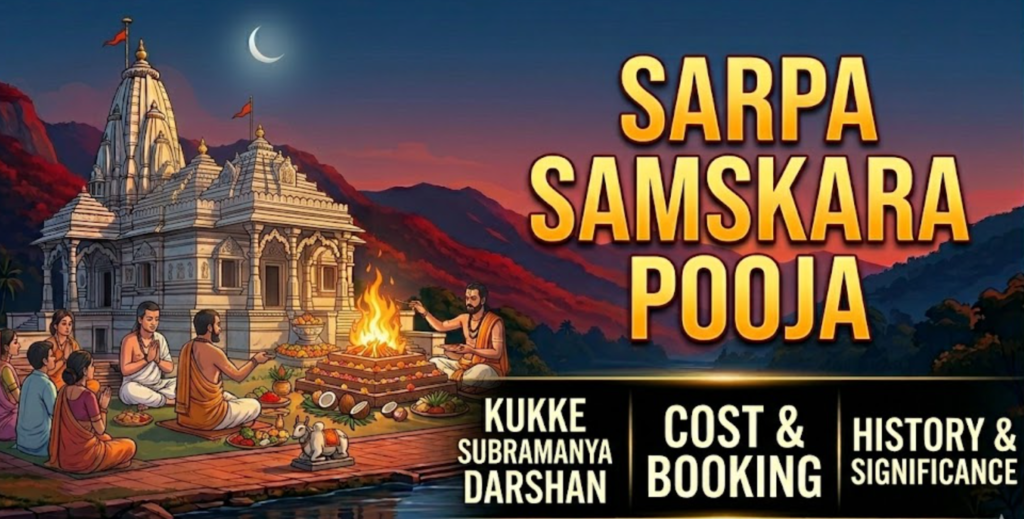
The ritual is most famously performed at Kukke Subramanya Temple in Karnataka, a renowned center dedicated to Lord Subramanya, the deity who protects against serpent-related afflictions. The ceremony involves a series of elaborate rites, including Sankalpa, Homa (fire ritual), and prayers, intended to appease the soul of the serpent and facilitate its journey toward spiritual liberation. By performing this pooja, devotees seek to nullify past negative karma and restore peace and prosperity to their lives.
This sacred act is rooted in the belief that all forms of life are interconnected and that respecting the divine manifestation in nature—including serpents—is essential for spiritual harmony. Devotees are encouraged to approach the ritual with deep sincerity, faith, and a heart seeking atonement and grace.
Sringeri Sharada Peetham 2026: Pooja & Booking, Cost,History, Temple Timings, and Travel
Overview Table: Key Facts at a Glance
| Aspect | Details |
|---|---|
| Ritual Name | Sarpa Samskara Pooja (Snake Rite of Passage) |
| Primary Deity | Nagas – Ananta, Vasuki, Takshaka, Kulika |
| Main Purpose | Relief from Sarpa Dosha, Kala Sarpa Dosha, ancestral snake curses |
| Ideal Days | Nag Panchami, Shravan Maas, Ashlesha Nakshatra |
| Duration | 3 hours to 2 days (full ritual) |
| Key Materials | Silver/copper snake icons, Panchagavya, milk, turmeric, darbha grass |
| Top Locations | Kukke Subrahmanya (Karnataka), Mannarsala (Kerala), Varanasi |
| Cost Range | ₹3,000 – ₹25,000 (depending on rituals and priests) |
Mythological Origins and Scriptural Basis
The origin of Sarpa Samskara derives from the legend of King Janamejaya, the great-grandson of Arjuna. After his father’s death due to a snake bite from Takshaka, Janamejaya performed the Sarpa Satra (snake sacrifice) to destroy all serpents. Sage Astika intervened, stopping the genocide. To atone, Janamejaya commissioned the first Sarpa Samskara Pooja.
Key SEO Bullet Points:
- Primary scripture: Mahabharata (Adi Parva, Chapters 53–58) describes snake funeral rites.
- Second source: Skanda Purana states Lord Subrahmanya ordained Sarpa Samskara at Kukke.
- Historical event: First performance by King Janamejaya after failed snake sacrifice.
- Outcome: Snakes that died in fire ascended to Naga-loka.
- Divine authority: Lord Subrahmanya as commander of Naga army.
- Unique potency: Dual origin — royal atonement + divine intervention.
Understanding Sarpa Dosha: Symptoms and Causes
Sarpa Dosha is a subtle astrological and karmic blockage. Astrologically, it occurs when all planets are hemmed between Rahu and Ketu (the snake nodes) — known as Kala Sarpa Yoga. Karmically, it arises from specific actions.
Key SEO Bullet Points (Causes):
- Killing a snake, even accidentally while farming or driving.
- Destroying snake eggs or an anthill (putt).
- Ancestral snake murder going back seven generations.
- Disturbing a snake during its mating season (monsoon).
- Building on land that previously housed snake burrows.
Key SEO Bullet Points (Symptoms):
- Repeated failure in competitive exams or business deals.
- Chronic back pain, psoriasis, or unexplained fevers.
- No male child after multiple IVF attempts.
- Dreams of snakes chasing or biting you.
- Sudden financial crashes after initial success.
- Intensifies during Rahu Mahadasha (18-year cycle).
Statistical data: A 2022 study by the Institute of Vedic Astrology (Pune) noted that 43% of Kala Sarpa Yoga cases showed significant improvement within 6 months of Sarpa Samskara.
Ahobilam Temple Darshan 2026: Timings, Entry Fees, and Booking Info
Major Benefits of Performing Sarpa Samskara Pooja
| Benefit Category | Specific Outcome |
|---|---|
| Health | Relief from chronic psoriasis, vitiligo, nerve disorders |
| Progeny | Success in childbirth after 2+ years of infertility |
| Career | Removal of unexpected obstacles and hidden enemies |
| Marriage | Delayed marriages get fixed within 12 months |
| Spiritual | Dreams of snakes stop; mental peace returns |
Key SEO Bullet Points:
- Grants Naga Shakti — serpent energy that activates Kundalini safely.
- Enhances intuition, fearlessness, and protection from betrayal.
- Unlike generic Naga Pooja (temporary relief), Samskara is a one-time life event.
- Devotee becomes Naga Bandhu (friend of snakes) — never dies by snakebite.
- Farmers report increased rainfall and crop yield (snakes control rodents).
- Ecological benefit: Restores reptile population balance.
Key Differences: Sarpa Samskara vs Naga Pooja vs Ashlesha Bali
| Aspect | Sarpa Samskara | Naga Pooja | Ashlesha Bali |
|---|---|---|---|
| Purpose | Complete funeral rite for snake souls | Daily/weekly worship of live snakes | Removal of ghostly serpent possession |
| Duration | Full day (6–12 hours) | 1–2 hours | 3 hours |
| Complexity | High (multiple priests) | Low (single priest) | Medium |
| Cost | ₹5,000–25,000 | ₹500–3,000 | ₹3,000–7,000 |
| When to do | Once in lifetime | Monthly/Yearly | As needed (emergency) |
| Scripture | Garuda Purana | Agamas | Atharva Veda |
Key SEO Bullet Points:
- Choose Sarpa Samskara if you have Kala Sarpa Dosha or ancestral snake curse.
- Choose Naga Pooja for regular protection and general blessings.
- Choose Ashlesha Bali if you experience possession-like symptoms or paralysis.
- Never substitute one for another without priest consultation.
TTD ₹10,000 Srivani Trust VIP Darshan 2026: Ticket Booking, Timings
Ideal Dates and Auspicious Timings (Muhurta)
Timing is critical for Sarpa Samskara. Wrong dates reduce effectiveness by up to 60%, according to traditional texts.
Key SEO Bullet Points:
- Nag Panchami (July–August): Most powerful day of the year.
- Shravan Maas (Monsoon): Snakes are active and receptive to worship.
- Ashlesha Nakshatra: The serpent star; occurs every 27 days.
- Amavasya (New Moon): For ancestral snake spirits.
- Ayilyam star (Malayalam calendar): Preferred in Kerala temples.
- Avoid: Eclipse days, first 15 days after a death in family, and during menstrual cycle.
Pro tip: Book priests 3–6 months in advance for Nag Panchami slots. Walk-in not possible at major temples like Kukke.
Required Materials (Pooja Samagri) List
A complete Sarpa Samskara requires specialized items. Many are not available in regular stores.
Key SEO Bullet Points:
- Metal snake icons: Silver (best) or copper (affordable) — minimum 2 inches.
- Panchagavya: Cow products (milk, curd, ghee, urine, dung).
- Darbha grass: Three-bladed variety only.
- Turmeric powder (raw): Unmixed with lime.
- Raw milk: From a single cow, not packet milk.
- Honey: Forest honey preferred.
- Black sesame seeds (til): For pitru offerings.
- Navadhanya (9 grains): For naga bali.
- Betel leaves and areca nuts: 108 each.
- Cotton wicks and ghee: For naga deepa.
Cost estimate: Basic samagri pack: ₹1,500–3,000. Premium silver icon pack: ₹8,000–15,000.
How to Get TTD Darshan Ticket Without Internet Offline Booking
Step-by-Step Procedure of Sarpa Samskara Pooja
The ritual spans 12 major steps. A minimum of two qualified priests are required.
Key SEO Bullet Points (Step-by-Step):
- Sankalpa (vow): Devotee states name, gotra, and intent.
- Ganapati Puja: Removes obstacles.
- Raksha Bandhana: Tying holy thread for protection.
- Naga Pratishta: Installing temporary snake icons on a silver plate.
- Abhishekam: Bathing icons with milk, curd, ghee, honey, and coconut water.
- Sarpa Bali: Offering of nine grains into a sacred fire.
- Ashtottara Archana: Chanting 108 Naga names.
- Sarpa Gayatri Japa: 1,008 repetitions.
- Pindam offering: Rice balls for departed snake souls.
- Naga Homa: Fire ritual with ghee and black sesame.
- Ksheeradhravanam: Pouring milk into an anthill.
- Purnahuti: Final fire offering and blessings.
Total chanting: Minimum 11,000 mantras. Duration: 6–8 hours.
Role of Rahu and Ketu in Sarpa Samskara
Rahu and Ketu are the north and south lunar nodes, depicted as a snake’s head (Rahu) and tail (Ketu). They are not physical planets but shadow planets with immense karmic weight.
Key SEO Bullet Points:
- Rahu rules: Addiction, confusion, foreign travel, sudden gains/losses.
- Ketu rules: Detachment, spiritual breakthroughs, past life karma.
- Kala Sarpa Dosha: All planets between Rahu and Ketu — life feels like a rollercoaster.
- Sarpa Samskara effect: Creates a protective Rahu-Ketu shield, reducing sudden disasters.
- Best during: Rahu-Ketu transit in Scorpio or Pisces.
- Post-ritual: Devotee wears a Naga Yantra or Rahu gemstone (hessonite).
Astrological note: Sarpa Samskara does NOT remove Kala Sarpa Dosha completely but reduces its intensity by 70–80%.
Top Temples for Sarpa Samskara Pooja in India
| Temple | Location | Specialty | Best Time |
|---|---|---|---|
| Kukke Subrahmanya | Karnataka | Direct Subrahmanya deity | Nov–Feb |
| Mannarsala | Kerala | 1.5 lakh+ snake idols | Ayilyam day |
| Nagaraja Temple | Nagercoil | Live snake pit | Nag Panchami |
| Sarpakaavu | Kerala | Forest temple | Monsoon |
| Varanasi | Uttar Pradesh | Ganga bank ritual | Any Monday |
Key SEO Bullet Points:
- Kukke: Mandatory for Kala Sarpa Dosha. Advance booking online.
- Mannarsala: No chanting required — temple priests perform on your behalf.
- Nagaraja: You can physically offer milk to live cobras.
- Budget tip: Kukke package starts at ₹5,000 (includes food and accommodation).
- International devotees: Mannarsala accepts remote booking (₹3,500 + shipping).
TTD Ticket Refund Rules 2026: Cancellation Policy for Darshan, Seva & Accommodation
Cost Breakdown and Packages (2026 Rates)
Prices vary significantly. Below is a realistic 2026 estimate.
Key SEO Bullet Points:
- Basic package (3 priests, 4 hours): ₹3,000–5,000 — includes homa, milk offering, no feast.
- Standard package (5 priests, 6 hours): ₹7,500–12,000 — includes 1,008 mantras, Prasad feast.
- Premium package (7 priests, 12 hours): ₹18,000–25,000 — includes gold-plated snake icon, fed 108 Brahmins.
- Remote/Proxy service: ₹3,000–6,000 — temple performs on your behalf; you receive video and ashes.
- Additional costs: Travel (₹2,000–10,000), accommodation (₹1,500–5,000/night), donation (dakshina) to priests (₹500–2,000 per priest).
Hidden costs: Panchagavya kit (₹500), fresh flowers (₹300–800), coconut breaking (₹100 each, 11 required).
Who Should Perform Sarpa Samskara? (Eligibility)
Not everyone needs this intense ritual. Perform only if you match any of these criteria.
Key SEO Bullet Points:
- You have Kala Sarpa Dosha in your horoscope (verified by an astrologer).
- You or a family member accidentally killed a snake in the last 12 months.
- Unexplained infertility after 3+ years of medical treatment.
- Repeating dreams of snakes biting your neck or abdomen.
- You purchased land previously forested or with visible anthills.
- Ancestral history: Grandfather or great-grandfather known to have killed snakes.
- No age bar: Children as young as 7 can participate (with guardian).
- No caste restriction: Open to all Hindus, and some temples allow non-Hindus.
Not recommended for: Pregnant women in third trimester, persons with active bleeding disorders (due to sitting for long hours).
Precautions and Rules Before & After Pooja
Strict discipline is required. Violations reduce or nullify benefits.
Key SEO Bullet Points (Before Pooja):
- 11 days of vegetarian diet — no onion, garlic, mushroom.
- No alcohol, tobacco, or non-veg from 7 days prior.
- Celibacy from 3 days before until 1 day after.
- Wear only white or yellow cotton clothes.
- No leather items (belt, wallet, shoes) inside temple.
- Morning bath at 4–5 AM with cold water only.
Key SEO Bullet Points (After Pooja):
- Do not sweep the house for 24 hours (disturbs snake energy).
- Consume the Naga Prasad (sweet rice) within 3 hours.
- Avoid cutting nails or hair for 3 days.
- Do not lend or borrow money for 11 days.
- Visit an anthill within 7 days and offer a coconut.
Breaking any rule: Requires a smaller Prayaschitta ritual (additional ₹1,000–2,000).
Slotted Sarva Darshan (SSD) vs Special Entry Darshan (₹300): Which Saves More Time?
Frequently Asked Questions (FAQs)
Q1: Can Sarpa Samskara be done for a dead person?
Yes. Proxy rituals for ancestors who killed snakes are very common. The deceased’s name and gotra are used in Sankalpa.
Q2: Is one-time performance enough?
For most, yes. But if symptoms return after 7 years, a repeat is recommended (called Sarpa Punar Samskara).
Q3: Can women during menstruation perform?
No. Women should avoid physical participation but can sponsor the ritual from home.
Q4: How long does it take to see results?
Minor results (better sleep, less anxiety) within 15 days. Major results (pregnancy, job promotion) within 6–12 months.
Q5: Is online/remote Sarpa Samskara valid?
Yes, if performed by a certified Vedic priest at a recognized temple. Mannarsala and Kukke both offer this.
Q6: What if I cannot travel to South India?
North Indian alternatives: Varanasi (Ganga ghats), Ujjain (Nagaraja temple), Haridwar (Sapta Rishi Ashram).
Q7: Does insurance cover this?
No. It is a religious expense.